Showing posts with label music. Show all posts

Sunday, January 21, 2024

Pandiatonicism 1; Is It a Thing?

The term "pandiatonicism" was coined by Nicolas Slonimsky in the second edition of Music Since 1900 (1938) to describe harmonic language that uses the notes of any diatonic scale in a non-tonal manner.

It is a somewhat problematic term for two reasons:

  1. It is partly defined by what it is not: It is not tonal, despite being based primarily on the diatonic notes of any key or scale.
  2. There appears to be no widely-accepted understanding of the term beyond acceptance of the idea that it involves almost exclusively diatonic notes; it is defined differently by different writers.

Regarding the first issue, let's explore how a composition can be based on the diatonic notes of a key or scale but not be tonal. I will suggest that the following conditions should apply:
  • It does not use functional harmony progressions, such as ii - V - I, IV - I, V - vi, etc., because these are the harmonic building blocks that establish a key in tonal music.
  • It does not follow the voice-leading conventions of tonality that apply to the resolution of tendency tones, which include:
    • Chord extensions: 7ths, 9ths, 11ths, and 13ths,
    • The leading tone in dominant harmony,
    • Suspensions and retardations,
    • The 5th of diminished chords.
  • The next two voice-leading practices are common in tonal music, but I don't think they apply to pandiatonicism:
    • The 6 & 4 of the cadential 6/4 (I don't see how pandiatonic music can have a cad. 6/4, since it is part of a progression that typically establishes a key),
    • Most chromatically-altered notes (this is irrelevant if only diatonic notes are used). 
  • Can pandiatonic music have a tonic chord or tonic note? As you can see in the discussion below there is disagreement on this. My feeling is that it can, as long as it is not established by the means used in tonal music. Establishing a tonic note or chord through non-tonal means can be challenging, but it is not impossible

Another problematic aspect is that it is defined differently by different people. For example:

  • The Wikipedia article on Pandiatonicism states that "all seven degrees of the diatonic scale [are] used freely in democratic equality."
    • I believe that this idea came from Slonminsky (1938). I take this to mean that there is no hierarchy of diatonic notes and triads, unlike tonal music, in which different notes and triads often have specific roles to play, such as dominant-function chords (V, vii°), predominant-function chords (IV, ii), and tonic chords.
    • The composer in me finds this to be an interesting idea. The problem with this description, however, is that I don't think that many of the works cited as examples of pandiatonicism have this quality (democratic equality of all diatonic notes).
  • Richard Kostelanetz, in A Dictionary of the Avant-Gardes (2013, 465) writes: "The functional importance of the primary triads...remains undiminished in pandiatonic harmony." (Wikipedia says that this "appears to be quoting Slonminsky," FWIW.)
    • I find this an odd statement. How is music in which primary triads have undiminished functional importance any different from tonality?
  • On the other hand, Bryan R. Simms argues that "pandiatonicism does not project a clear and stable tonic" (Music of the Twentieth Century: Style and Structure (1986, 63-64). 
    • This is closer to my understanding of pandiatonicism.
  • Also from Wikipedia: "Pandiatonic music typically uses the diatonic notes freely in dissonant combinations without conventional resolutions and/or without standard chord progressions, but always with a strong sense of tonality due to the absence of chromatics."
    • I agree with the everything in the above statement until the last part: "always with a strong sense of tonality due to the absence of chromatics.
    • Wait… what? There are two problems with this statement:
      1. Tonality isn't defined by an "absence of chromatics." Almost all tonal music uses chromaticism, such as modulation, applied dominants, mode mixture, augmented sixth chords, etc., at least in classical and jazz music. "Chromaticism" comes from the Greek word for "colour," which conveys the implication that music without it is colourless.
      2. If you play a random series of pointillistic white notes or white note clusters on piano, will it necessarily result in music with a "strong sense of tonality?" Tonality isn't just about the notes used in a passage of music; it's about the way those notes are used. The only way for music to have a "strong sense of tonality" is for it to be tonal, which usually includes chromaticism.
  • In Slonminky's 1947 edition of his Music Since 1900 he suggested that pandiatonicism can be considered to be "a diatonic counterpart of Arnold Schoenberg's twelve-tone technique, whereby melodies may be made up of seven different notes of the diatonic scale, and then be inverted, retrograded, or both. According to this system, "strict pandiatonic counterpoint" may use progressions of seven different notes in each voice, with no vertical duplication" ("Pandiatonicism," in Wikipedia, the Free Encyclopedia. Retrieved 21 Jan, 2024).  
    • This is an interesting compositional idea that might be fun to try, but I would suggest that almost no works that get cited as examples of pandiatonicism have this quality.
    • I will also suggest that Slonminsky was writing as an advocate for the concept of pantdiatonicism here, not as an impartial scholar making observations on existing musical practices. I'm not sure that he included any examples of diatonic serialism. This is not to suggest that such examples don't exist – Aaron Copland tried this, and possibly Stravinsky as well (I'll try to do some more research to find out more about this).
Here is my suggestion for composition students: I encourage you to try writing something that can be considered pandiatonic if the idea interests you.

However, given the fact that a universally agreed-upon definition of pandiatonicism does not exist, I would to suggest the following guidelines:
  1. Avoid anything in melodic lines or harmonic progressions that suggests tonality.
  2. Avoid establishing a tonic. Or if this is too disturbing, establish a tonic, but not by any method associated with tonality; for example, Ti-Do and So-Do, if supported by dominant-to-tonic (or dominant to sub-mediant) harmony, are overtly tonal and should therefore be avoided.
    → On the other hand, if Ti-Do is supported by non-tonic-to-dominant harmony, such as iii to ii7, or I7 to IV, it is available.
  3. Aim to use all pitches of whatever scale you use equitably and democratically.
  4. Triads may be used only if they do not progress as they do in tonal music.
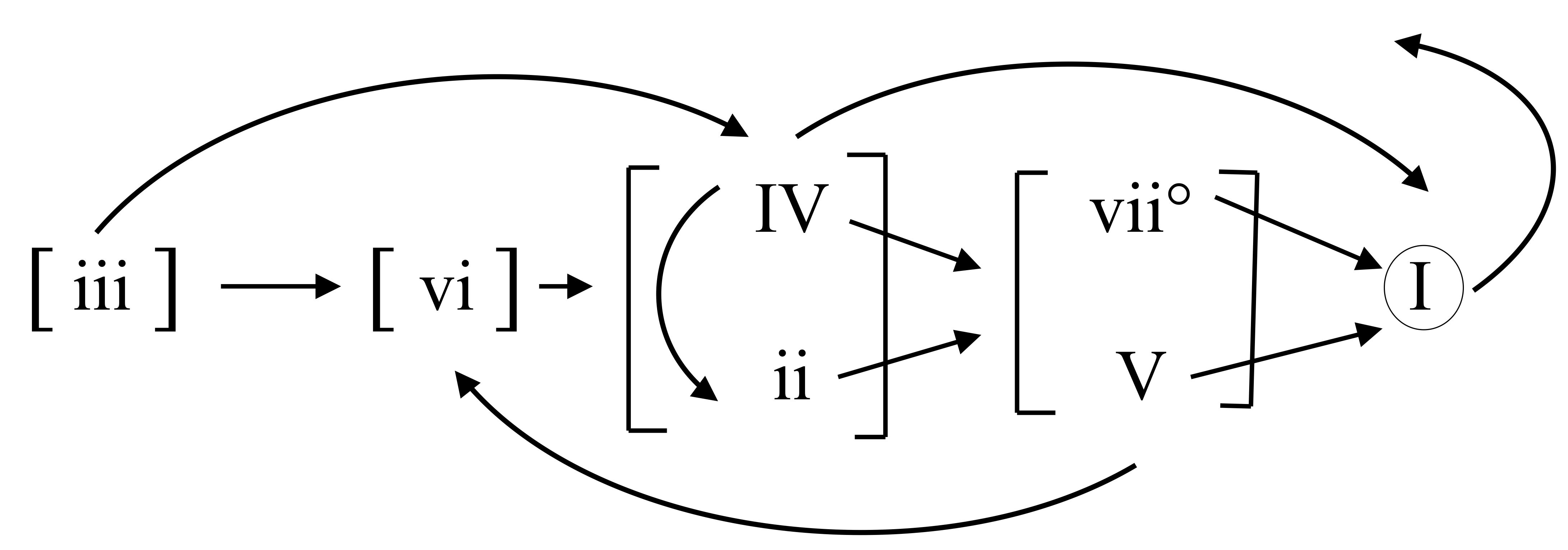
    → See the Kostka & Payne chord progression chart below for a summary of how diatonic chords usually progress in tonal music.
  5. Try to use non-triadic constructions as well, such as quartal and quintal harmony.
    → One challenge in using these types of harmonies is that, depending on what note you start on, you might end up with accidentals if trying to maintain a vertical structure of perfect fourths, such as C - F - Bb - Eb - Ab, etc. While occasional accidentals are fine in pandiatonicism, for the most part the objective is to avoid them. They are fine if required for modulations, however.
    → If you want to write quartal harmony using only perfect fourths and white notes (i.e., no accidentals), for example, you could build up from B: B - E - A - D - G - C - F.
    → If you want to try this with quintal harmony, build up from the last note above (F): F - C - G - D - A - E - B.
  6. Give Slonminsky's serialist diatonicism a try if you wish.
You may find it challenging to write music you enjoy without borrowing common practices from tonal music; therein lies the reason tonal music is so widely embraced: Its practices have evolved over centuries to sound good to Western ears. We talk about Ti "wanting" to rise to Do in a V-I progression, or of a chord seventh "wanting" to resolve down by step to a consonance in the next chord, or a 4 "wanting" to resolve down to 3 in a 4-3 suspension, because these practices sound good or "right" to our ears, so writing tonal music in which these practices are not followed can feel very "wrong" to us.
(On a side note, I am curious to know if the tonal music practices that sound "right" to our ears have corollaries in music of other cultures, such as South-Indian classical music, or traditional Chinese music. Do they use anything like dominant-tonic harmony?)
For this reason, you may find it easier to write pandiatonic music that avoids triadic progressions, such as Slonminsky's serialist approach to diatonicism, or pointillistic music in which widely-spaced notes are distributed in unpredictable ways.

I'll stop here for now; I will post some links to pandiatonic music in my next blog post.

Please let me know your thoughts below in the comments section!


How diatonic chords in classical music usually progress: Chord-Flow Chart (from Kostka, Stefan M., and Dorothy Payne. Tonal harmony: With an introduction to twentieth-Century music. New York etc.: McGraw-Hill, 2009. P. 111):


Check out the next post, Pandiatonicism 2, to listen to various works that some have claimed to be pandiatonic.


You may also like these posts on Post-Tonal Harmony Ideas:


Tuesday, January 24, 2017

Music Notation Software – Pros and Cons for Composers

There are several music notation programmes available for computers and tablets, but the brands that I suspect most composers use are Finale and Sibelius. Another excellent notation product is Notability Pro (for Mac only), which some composers I know swear is the best product out there, and is now free.

In today’s post, I will explore how the use of notation software can affect the composition process, in ways we may not realize, both positive and negative. The first seven points below list many of the unambiguously-positive aspects of using notation software, and the remaining points concern some of the potential challenges that can arise from its use, some of which we may be unaware of.

If any readers can think of pros and cons not listed below, please let me know via the "comments" area, and I'll add them to the list if merited.

Music Notation Software
Pros
Cons (or commentary on pros)
1. Can produce polished, publication-ready scores. 1. This is indeed true. However, it takes considerable skill, and the knowledge of all the minutiae of notation conventions, to produce publication-ready scores, whether one uses notation software or not.

Because a score produced with notation software generally looks far better than a hand-copied score (although some highly-skilled hand-copyists can also produce beautiful scores), we may be seduced into thinking our score is as good as it needs to be, when in fact it may need a lot more detailed work to reach a point of being truly publication ready.
2. Scores look better than hand-copied scores. 2. This is generally true. I doubt that many students are trained in the art of hand-copying music any more (I was, which reflects the period in which I was trained (cretaceous)) – but it isn’t always true; a sloppy computer-notated score looks far worse than a beautiful and meticulous hand-copied score.

Again, this is more a product of the user's limitations than of the software, however.
3. Pitches and accidentals are notated clearly and correctly.

3. No disadvantages! Here are some of the reasons this is such a valuable advantage for notation software:

• Sometimes, in hand-copied scores, pitches are less than 100% clear because they are notated in such as way as to "spill" into the territory of an adjacent pitch.

• Notation software also notates 2nds correctly. Sometimes, in a hand-copied score, students attempt to vertically align notes that are a second apart, which looks very messy.

• Notation software also aligns accidentals correctly (again, students sometimes try to fit them on top of each other, causing collisions and all manner of visual mayhem).
4. Other score information, such as text and articulations, is clear (hand-written text can be somewhat challenging to read if a composer has poor calligraphy skills). 4. This again is generally true, unless the composer uses a font or font-size that is difficult to read.
5. You can remove or add bars without recopying entire pages.

• It is also easier to change/add/remove notes and any other score information (such as dynamics, slurs, articulations, text, etc.

• Software also lets you do A/B comparisons, listening to a version with bars added, and then comparing with a version with those bars removed.
5. This is a huge advantage of notation software; having to recopy an entire page by hand in order to add or subtract a few bars is such a hassle that it can become a disincentive to make such changes. Anything that gets in the way of making even small improvements in your compositions is a significant problem.

•And yes, the possibility of doing numerous A/B listening comparisons is a tremendous advantage in using notation software.
6. Parts can be generated automatically.

• This is a huge advantage in using notation software.
6. Generating parts can still involve some work, however, because you may need to adjust the layout, number of bars per system, fix any new collisions that may have shown up, plan page turns, do any necessary last-minute edits (you sometimes notice problems in parts that you didn't notice in the score), etc. But there's no question that generating parts is a much faster process with notation software.
7. Transpose, Invert, Retrograde, and other commands, as well as plug-ins.

• Did you know that Finale has commands for melodic inversion, and retrograde? These (particularly inversion) can be useful when considering possibilities of how to grow/extend/transform a melodic idea.

• There are also third-party plugins available, such as Patterson Plug-Ins for Finale,  which are designed to speed up and generally improve workflow.
7. Composers can obviously do these things without a computer, but the computer does them much faster. Plus, having these options so readily available makes it easier to try them in order to see if they can be used in your composition.
8. Dynamics look as they should, and are usually well positioned. 8. Notation software does indeed produce dynamics that are beautiful.

• They are not always well positioned however; in Finale, you have probably found many cases where a dynamic collides with something else, such as an accidental, note, or slur, which requires the user to re-position the dynamic, or the other objects with which it collides; I'm not sure this happens as frequently in hand copied scores.

• One potential issue to be aware of is that in some software programmes, a dynamic intended for one instrument (e.g., below the flute staff) in an orchestral score can show up in an adjacent instrument's part (e.g., above the clarinet) when parts are generated. When positioning a dynamic, Finale uses a temporary dashed line to indicate the note to which the dynamic is attached, which reduces the likelihood of misplaced dynamics.

• There are potential playback issues in the use of dynamics, described in section 9.
9. You can hear what you write as you write it, performed at the indicated tempo, or at a slower tempo if you prefer, which allows you to listen repeatedly, carefully, and critically.

• You can also hear and evaluate any indicated tempo changes (including rit. and accel.), and dynamic levels (including cresc. and dim.).

• You can also listen to the composition, or a section thereof, repeatedly, tweaking it until it sounds as good as you can make it, no matter what time of day you play it, and no matter what your mood is.
9. Being able to hear an approximation of what you write in real time is a huge benefit of notation software.

• There are, however, significant issues or limitations in relying too heavily on MIDI playback as a realistic indicator of what your music will sound like; these include:
  • Unwittingly writing parts that are either extremely difficult or even unplayable, because the computer plays them without any problem whatsoever (!). A computer plays unidiomatic lines flawlessly, while a performer might struggle in attempting to play them, or even refuse to play the piece. The computer can lull the user into thinking that the line is perfectly idiomatic, when in fact it is extremely difficult or even impossible. I am not sure how much different this would be in a hand-copied score, but in producing a hand-copied score, a composer usually spends hours playing each line, usually on a piano, which might flag any such issue;
  • Balance problems: The balance in a MIDI ensemble is often not very realistic; 
  • Further to  balance problems, sometimes, in an attempt to bring out a line that is insufficiently prominent, we may temporarily give it an extreme dynamic boost, such as marking it fff instead of f, so we can hear it better in the MIDI playback, but then forget to change the dynamic to its correct value (fff back to f) before giving the parts to the performers, resulting in performers blasting the heck out of that line in the first rehearsal, when all we intended was for it to be more prominent than the lines around it. Or sometimes, an inexperienced composer may use an extreme dynamic boost (e.g., f to fff) intentionally, thinking it necessary to bring out the line to the desired level, perhaps not realizing that if a line is marked  f, while the other instruments are marked mf, the performers and/or conductor will make sure that the f line is heard more prominently than the others.
  • It is also possible that the previous example (extreme dynamic boost) might be the result of poor orchestration; if a musical line is insufficiently prominent in MIDI playback, perhaps it needs to be reinforced in some way (e.g., octave doublings, or the addition of other instruments to that line), or perhaps the material around it is too busy and needs to be thinned out in some way.
  • Unrealistic representation of the nuanced colour and dynamic changes in different registers of an instrument or voice; 
  • MIDI playback is only as good as the quality of the samples  in your computer's sound-bank. 
  • Glissandi, heard through MIDI playback, usually elicits a chuckle from class members, presumably because it often sounds so unrealistic or even ridiculous.
  • The computer will play any glissando, even impossible ones, which may entice composers into writing impossible glissandi. We need to be aware of the possible glissandi for different instruments; always show your work to a performer of that instrument to be sure.
10. Copy and Paste.

• Musical material, from the smallest ideas to entire sections, is often repeated, either immediately or brought back later; the Copy & Paste functions let you do this with great ease.
10. Again, a very useful tool. I recommend exercising some restraint in its use, however.

• One of the most wonderful attributes of great classical compositions is that ideas are often altered in some way when repeating or recapitulating them. This provides both the comfort of familiarity, since we recognize the ideas, but also an element of surprise, if we recognize that some aspects have been changed.

• You can make such modifications when repeating ideas in notation programmes, of course, but, at least in student work, it seems as though the ease with which the paste command can be executed often leads to not making modifications.

• My advice to students is to explore modification possibilities when re-using (pasting) an earlier idea into a later section.
11. Other limitations and challenges. 11. Using different metres in different staves simultaneously, and having bar lines that don't necessarily line up with each other (vertically).
12. Other limitations and challenges. 12. Using a time grid at the top of your score (e.g., a grid in 5 second increments), with no bar lines.

• You can hide bar lines, of course, and create a graphic to represent the time grid, but this involves more work than it would if done by hand.
13. Other limitations and challenges. 13. Graphic notation can be difficult or even impossible.

• Again, you can create graphics on a computer, but it takes some skill to do this well, and doing it by hand is often faster.
14. Other limitations and challenges. 14. Oversize metres in orchestral scores (e.g., a large 4/4 that spans the height of the entire woodwind section) are either impossible or very tricky. Oversize metres are generally much appreciated by conductors, because they can be easily read at a glance. When my orchestral music has been played, I often get the score back with oversize metre changes written in by the conductor.
15. Other limitations and challenges. 15. Unless you invest in an expensive sample library that includes extended techniques in all instrument families, your MIDI playback will probably not be able to reproduce such sounds. This is not necessarily an impediment to using extended techniques, but I suspect they would be used more if we could hear a reasonably-accurate reproduction of these techniques during playback of our scores.

These performance techniques include: col legno, col legno battute, sul pont., sul tasto, different mute types for brass instruments, hand-stopped notes (for horn), play with bells in the air, multiphonics, flutter-tongue, harmonics, harmonic gliss. ("seagull effect") for strings (particularly for cello), senza vibrato, scraping sound created by heavy bow pressure and slow bow speed, a myriad of sounds available by slapping, scraping, muting, picking (with a guitar pick) strings inside of a piano, prepared piano sounds, etc.

Have I missed any significant advantages or disadvantages in my list? Are there times when you feel the notation software is pushing you to notate an idea in the way that it wants, as opposed to the way that you want? Please let me know in the comments section below, and thanks for reading!

Sunday, September 18, 2016

Post-Tonal Harmony Ideas (1)

1. Post-Tonal Harmony

"Post-Tonal" Harmony refers to harmonic practices not based on tonality that emerged since the end of the nineteenth century.

Basically, this includes any variety of atonality, such as free (i.e., non-serial) atonality and serialism, but, at least in my definition, it could also include music based on Messiaen's modes of limited transposition (or other constructed modes), quartal and quintal harmony, bitonality (provided it does not sound like tonality with chord extensions), and even the use of chords borrowed from tonality, but not used in a tonal context. A longer, but by no means comprehensive, list can be found in an earlier blog post I wrote (A Sampling of Post-Tonal Techniques and Ideas for Composition), and there are many on-line sites with information on this topic.

2. Atonal Harmony

"Atonality" which can be thought of as a sub-genre of post-tonality, tends to be defined more narrowly. Here is the opening paragraph of Wikipedia's article on Atonality:
Atonality in its broadest sense is music that lacks a tonal center, or key. Atonality, in this sense, usually describes compositions written from about 1908 to the present day where a hierarchy of pitches focusing on a single, central tone is not used, and the notes of the chromatic scale function independently of one another (Kennedy 1994). More narrowly, the term atonality describes music that does not conform to the system of tonal hierarchies that characterized classical European music between the seventeenth and nineteenth centuries (Lansky, Perle, and Headlam 2001). "The repertory of atonal music is characterized by the occurrence of pitches in novel combinations, as well as by the occurrence of familiar pitch combinations in unfamiliar environments" (Forte 1977).
To be clear, my definition of post-tonality is considerably less restrictive than the opening sentences of the Wikipedia article above, which appear to preclude the possibility of pitch-centres in atonal music.

3. Pitch Centricity

The idea of "pitch centricity" – music that is based in some way on a pitch centre – is inherent to tonal and modal music, but many (click this link, and/or Google the term) argue that it is also relatively common in atonal/post-tonal music.

I agree with this, which is why I often encourage students to write some variety of post-tonal music with pitch centres, and to move between different pitch centres within a composition, borrowing from tonality the concept of departure from, and return to, a "home" pitch centre, using various "modulations" along the way. A fellow composer and long-time friend of mine, Omar Daniel (who teaches at Western University), once told me something along the lines of, "one of the biggest problems I see in student compositions is an unwillingness to modulate," by which he meant change pitch centre, not change key. I think.

4. Can Post-Tonal Music use Triadic structures from Tonality?

Quick answer: Yes, it is fine to use harmonies borrowed from tonality (e.g., major, minor, diminished, dominant sevenths, etc.) in post-tonal music, as long as they are removed from their hierarchical/functional context within tonality. Indeed, that is the main topic of today's blog, and if you want to skip ahead for examples of how this can be done, scroll down to #8 below.

If part of our definition of post-tonal harmony is "harmonic practices not based on tonality," it would be useful to understand what we mean by tonality.

5. Tonal Harmony

Tonality refers to a systematic approach to musical composition using major and minor scales, based on:
  1. Hierarchical chord-progression practices involving chord functions (e.g. pre-dominant to dominant to tonic class; );
  2. Relationships between notes, such as contextual attractions or tendencies (e.g., leading-tone resolution in dominant harmony (^7-^8));
  3. Resolutions of perceived instabilities (e.g., chord 7ths, suspensions, and other non-chord tones).

6. Common Chord Progressions Found in Tonal Music; A Chord-Flow Chart

"Hierarchical chord-progression practices" in tonality refers most generally to the chords that establish a key, namely dominant – tonic harmony, and predominant – dominant – tonic harmony. This is the basis of the following chord-flow chart, as found in Tonal Harmony, by Stefan Kostka and Dorothy Payne (McGraw-Hill):

By the way, this is a diatonic version of the chart for major keys, but it is virtually identical in minor keys. Chromatic variants of the above chords usually function as their diatonic versions, so bIII functions as iii, bVII functions as vii°, bVI functions as vi, etc. Also, there are exceptions to this chart found in the music of many composers of tonal music; the chart is a pedagogical tool, meant to represent the chord-flow options that are usually found in tonal music.

7. Does this mean chord progressions that do not follow the above chart are post-tonal?

Not necessarily; V - IV - I is a relatively common pop and blues chord progression that is clearly tonal, and yet V to IV is not available in the chart, and there are other exceptions as well (another common one is bVII - IV - I).

The following progression, in which every chord after the third does not follow the above chart, is clearly tonal. It consists of a descending C-major scale with a first-inversion triad on every note. This is an example of "parallel-sixth chords," wherein passing sonorities are not considered to be functional; the underlying functional harmony would be I6 - V6 - I6:


8. Finally! Some Post-Tonal Options: Combining and Recontextualizing Chords to produce Post-Tonal Sonorities; You won't BELIEVE #3!

As stated previously, my definition of post-tonality is fairly open; harmonic practices that came after tonality and are not tonal can be considered to be post-tonal. This would include post-tonal music that combines triads (or seventh chords, or ninths, etc.) found in tonality in such as way as to produce sonorities that are clearly not tonal and are not used within a tonal context.

Here are some examples; play the audio file below each example to hear what they sound like:

1. This is based on the combined C major and F# major chords (i.e., two major chords whose roots are a tritone apart) found in Stravinsky's Petrushka (1911); I added a three-note figure with two additional pitches (Ab and D) at the end, because I like the sound:


2. This begins with a C7 chord, upon which four additional pitches based on a B° triad are added:


3. The next example starts with a D7 chord that becomes a D9 on the third beat of the bar; a G#m chord with a major seventh and major ninth is superimposed:

• Examples 2 and 3 above, which began with dominant seventh chords, could be used in a tonal context, if the dominants resolved to their expected tonics within tonal music. #2 could therefore resolve to an F chord, and #3 could resolve to a G chord. Try this yourself, if you can access a keyboard, to hear what this would sound like.
• Therefore, in order for the above examples to truly be post-tonal, they should not progress to any chords that could be interpreted as constituting a progression of functional harmony.   
 4. The next example uses quartal harmony, but, instead of stacking a series of perfect fourths on top of one another, which creates a pleasant-but-static quality, I stacked two perfect fourths, then went down by whole tone and stacked two more perfect fourths on that note, then repeated it a third time, finishing with three stacked fourths instead of two. The result is very different than just stacking fourths on top of one another until you run out of notes:


Try superimposing different chord combinations, notating any you like and/or find to be of potential use in your compositions. Feel free to borrow any of the examples above as well. You don't need to limit yourself to chords, either; you can start with a chord and then add to it different notes or scalar passages that happen to sound good, and help recontextualize the chord so that it no longer sounds like a traditional tonal sonority.

9. But Wait! There's More! Tonal Chords Progressing in a Non-Tonal Way

Another way to present tonal chords in a post-tonal context is to create progressions that consistently and deliberately do not follow the above chord-flow chart, and do so in a way that prevents any suggestion of a clear tonic chord and functional harmony. If you try this, you may find that it is a surprisingly difficult task to create a chord progression that doesn't sound "wrong" to your ears.

This may be due to the strongly tonal association each individual chord has, since each individual chord in such a progression is typically major or minor; when recognizable chord-types do not "behave" (i.e., progress) as we expect them to, it can be disconcerting. In the section 8 examples above, where different chords were superimposed, the resulting vertical structures were not traditional tonal chords, and thus created fewer expectations that they "ought" to progress in a tonal way.
– – – – –
Giant Steps is a John Coltrane jazz composition so seminal that its chord progression is known as the "Coltrane changes;" it is required learning for any gigging jazz musician. Although it is tonal, it uses some unexpected chord changes: BMaj7 to D7, GMaj7 to B, and EMaj7 to F#7; these are somewhat unusual progressions in tonal music, although they are common enough that there is a name for them: Each chord pair forms a chromatic-mediant relationship. Not only that, and this is probably what makes it sound so unusual, but the first chord of each of the chromatic-mediant pairs also forms a chromatic-mediant relationship with the first chord of the next pair, and the same is true for the second chord of each pair as well.

It also uses some very common progressions, notably, several V7-I tonicizations. However, each tonicized chord (GE, and B) is a major third from the next one, which means that together, they outline an augmented triad; this is highly-unusual! It is usually played very quickly, which helps make the augmented triad of tonicized roots even more evident:


Again, Giant Steps is tonal, but you can explore the possibility of using tonal triadic structures (i.e., major, minor, diminished, etc. chords, possibly with chord extensions like 7ths, 9ths, etc.) in a post-tonal context by writing chord progressions that do not follow our chord-flow chart above, taking particular care to avoid any hint of ii - V - I progressions, which are used to establish keys in tonal music. As mentioned above, You may find this a challenging task, but if you do come up with any you'd be willing to share, please do so in the comments section!

Here's one attempt; some of it uses double-chromatic-mediant relationships (two triads a third apart with no notes in common), some uses chromatic-mediant relationships (two triads a third apart with one note in common), and there are some non-tertian root movements as well. To my ears, it succeeds in avoiding being tonal (at least in any obvious way), but does it succeed as a musically-useful chord progression?


10. And That's Not All!

While this last approach above can produce useful results, I find that a much more satisfying and rewarding approach is to write a progression of non-tonal harmonies, each of which would be the result of sitting at a piano and just trying different harmonic sonorities until you find one you like or consider to be useful, and repeating this until you have perhaps 12-16 chords. If you'd like learn more about this approach, it is described in greater detail in this blog post: Project 1: Writing an Atonal Theme and Variations. In my experience as a teacher, it has produced some of the best work I have heard from early-stage composition students.

One of the keys to growth and improvement as a composer is to be willing to try new things; I encourage you to experiment with these approaches and many others.

Tuesday, September 6, 2016

Blog Index — Organized by Topic (®Sept/2016)

Welcome to another year of composition studies! I wish you much growth and success on your journey to becoming the best composer you can be.

My primary motivation in creating this blog was to provide a forum in which a variety of composition-related topics could be explored and discussed in greater depth than is feasible in the classes I teach at Memorial University. While this was created for my students, comments may be left by anyone. Periodically, spam-bots leave comments, usually characterized by their enthusiastic brevity, followed by a link of some sort, kind of like this: "Great post! It really made me think. Check out DezynerSunGlassez.con for fantastic deals!"

Other times the spam-bot leaves some incredibly long-winded word collection, possibly copied from some obscure technical manual. I have no idea what the point of any of these spam posts is, but, if you see a comment that even vaguely resembles spam, do not click on any links, and let me know about it asap.

I get an automatic notification anytime someone leaves a comment, no matter how old the post, so, feel free to comment on very old posts if the topic interests you.

Below is an index of most blogs posted thus far. Entries relating to class business – reminders of deadlines, concert congratulations, order of class presentation, etc. – are omitted.

Links are loosely organized by topic to facilitate browsing.


→ Exploring the Creative Process; Struggles and Solutions ←
Strike While the Iron is Hot! (includes section on "writer's block")

→ Planning ←

→ Playing With Expectations; Musical Dichotomies ←

→ Composition Techniques 

→ Form in Post-Tonal Music ←

→ Atonality; What's in a Name? ←


→ Winning and Losing; Judging and Being Judged ←

→ Audience Response to Contemporary Classical Music and Marketing ←

→ Composition Issues (10-part series that started this blog) ←
1.1. The quality of ideas may not matter very much in assessing compositions that emerge from them; and
1.2. The degree to which these ideas are original may not matter very much.
2.1. Study the music of others.
2.2. Compose as much as you can.
2.3. Invite criticism from others.
3.1. Live with it for a while.
3.2. What is it about?
3.3. Does it change character?
3.4. What is its function within the context of the piece?
3.5. Structural Analysis.
3.6. Harmonic (or Pitch, Scale, etc.) Analysis.
7.1. Less is more / More is more
7.2. Always leave them wanting more / Give them what they want
7.3. Don't treat the listener like an idiot / There's a sucker born every minute
7.4. There can be too much of a good thing / If you have a good idea, then stick with it!
7.5. The George Costanza approach.
8.1. Three models for the role of a composer
8.2. Mastery or Mystery?
8.3. The value of a plan
8.4. Getting stuck, and possible workarounds
8.5. Don't obsess
8.6. Challenges = Opportunities

→ Composition Projects ←

Saturday, January 16, 2016

Blog Index — Organized by Topic (®Jan/2016)

Below is an index of most blogs posted thus far. Entries relating to class business – reminders of deadlines, concert congratulations, order of class presentation, etc. – are omitted.

Links are loosely organized by topic to facilitate browsing.


→ Exploring the Creative Process; Struggles and Solutions ←
Strike While the Iron is Hot! (includes section on "writer's block")

→ Planning ←

→ Playing With Expectations; Musical Dichotomies ←

→ Composition Techniques 

→ Form in Post-Tonal Music ←

→ Atonality; What's in a Name? ←


→ Winning and Losing; Judging and Being Judged ←

→ Audience Response to Contemporary Classical Music and Marketing ←

→ Composition Issues (10-part series that started this blog) ←
1.1. The quality of ideas may not matter very much in assessing compositions that emerge from them; and
1.2. The degree to which these ideas are original may not matter very much.
2.1. Study the music of others.
2.2. Compose as much as you can.
2.3. Invite criticism from others.
3.1. Live with it for a while.
3.2. What is it about?
3.3. Does it change character?
3.4. What is its function within the context of the piece?
3.5. Structural Analysis.
3.6. Harmonic (or Pitch, Scale, etc.) Analysis.
7.1. Less is more / More is more
7.2. Always leave them wanting more / Give them what they want
7.3. Don't treat the listener like an idiot / There's a sucker born every minute
7.4. There can be too much of a good thing / If you have a good idea, then stick with it!
7.5. The George Costanza approach.
8.1. Three models for the role of a composer
8.2. Mastery or Mystery?
8.3. The value of a plan
8.4. Getting stuck, and possible workarounds
8.5. Don't obsess
8.6. Challenges = Opportunities

→ Composition Projects ←