I think it arises in part because of the extreme disproportion between the length of time it takes to compose music, and the length of time it takes to hear it; you can spend days working on a musical idea that lasts only 30 seconds. After spending so much time working on a musical idea, it is easy to tire of it and want to start working on a different idea.
I think it also comes about because we just don't have all the tools we need to construct longer, motivically-related (and therefore organic) sections of music.
One suggestion to counteract this is to practice writing single lines of significant length, perhaps 32 bars or longer, without concerning yourself with harmony, counterpoint, or orchestration; focus only on building, or "spinning out," your line. This can help you to grow your musical ideas into longer entities, which in turn gives you a better sense of how to construct longer compositions with proportions and musical ideas that feel organic.
A term for melodies that are "spun" from limited motivic resources is fortspinnung; here is an example by J. S. Bach, from his Invention in D minor, BWV 775; the fortspinnung begins in bar 5:
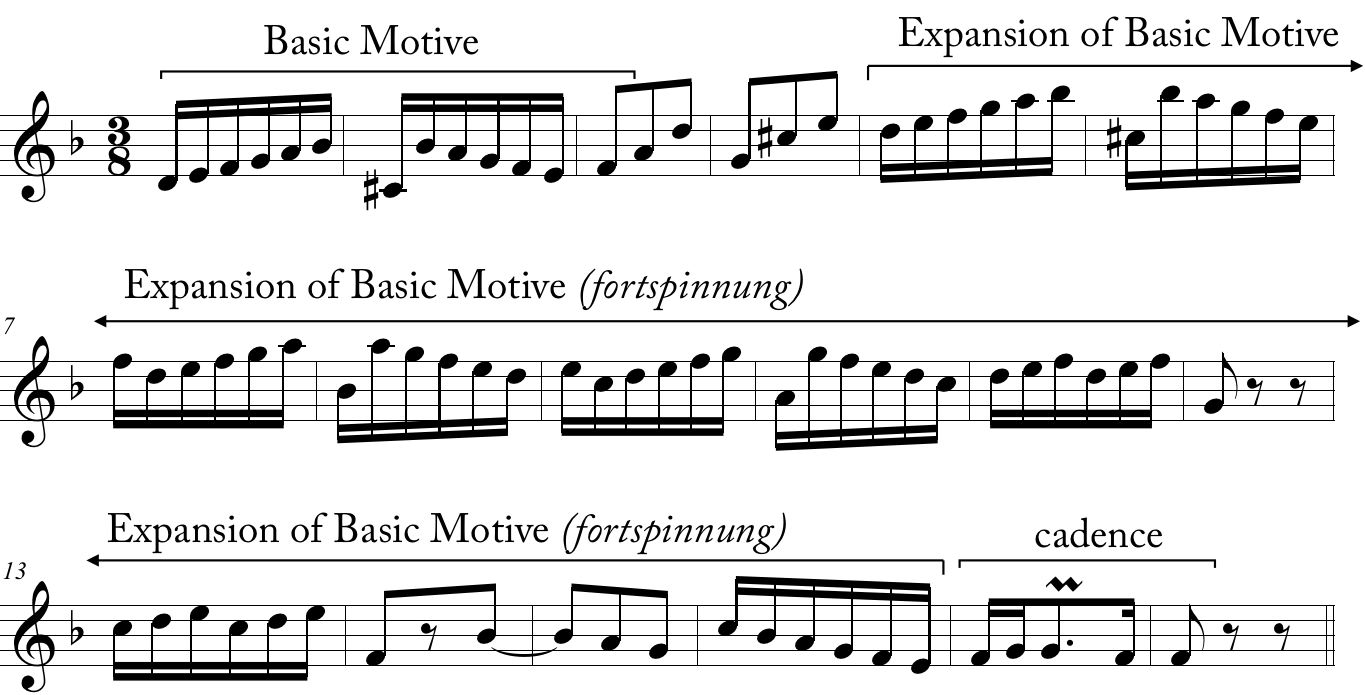
For ideas that are colour based — the principal interest is harmonic, textural, or the orchestration — this technique works less well, but you may be be able to adapt it by writing your harmonic progression on one or two staves which continue for as long as the progression needs to last. You could also insert indications such as, "flutes and oboes here," "only use bass-register instruments," or "light, transparent texture," to guide you when you come back to orchestrate or otherwise expand your short score to its fuller form.
Do all musical materials need to be worked out to their full potential? Absolutely not! But a sense that none of the ideas has reached some kind of musical maturity may lead to a feeling of dissatisfaction about the composition in general for listeners.
Also, just because you work out an idea to achieve its full potential beforehand doesn't mean you have to use the idea in its entirety the first (or any) time the listener hears it. You could introduce it in segments, interrupted by a contrasting idea, gradually working its way to the full presentation of the idea.
Don't buy it? I have a theory that all composers are contrarians to varying degrees. When a teacher says, "avoid parallel fifths," an aspiring composer may say, "oh yeah? We'll just see about that!" and decide to write a piece using nothing but parallel fifths, and ditto for any other musical 'rule' or 'guideline.' So, even as I write this, a part of my brain is saying, "but wouldn't it be cool to write a piece with absolutely no sense of thematic growth or fulfillment whatsoever?
My answer would be, that if you feel that way, then give it a try! But perhaps not in my course… Centuries of musical practice suggest it is important to learn how to 'grow' your musical materials in a natural and organic way, which is why composition teachers often encourage their students to develop the skills and patience to work on this.


 Posts
Posts


26 comments:
I find myself writing, and then mid-phrase, a new idea pops into my head, and I want to use that too, followed by more material...it becomes a web of ideas. Even though I follow a strictly planned approach to composition, sometimes the abundance of ideas takes over the careful planning and results in a disconnected piece. I'm working to make transitions clearer and develop musical motifs to their full potential.
I think I have compositional a.d.d, thats all.
I get bored with one thing and get an awesome idea and then get way too excited about that idea and then the other one that i worked on seems like a bore (sometimes!).
And sometimes this works out great for me because maybe my initial ideas are the greatest and then other ideas spring from them to make better ideas.
Writing a long section is probably the biggest challenge for me. Keeping my ideas going while keeping material fresh is a hard task to accomplish. However, I find that writing for concert band is easier (so far-knock on wood) to expand ideas because there are so many color changes available and so many instruments for experimentation!
Also, how can anyone be sure that their musical ideas have reached their potential or not? It is just a case of satisfaction with what you hear? It's probably also pretty bad to over-develop your material. Where is the balance? I will strive to find one someday!
This is a really interesting topic! I started writing a reply, but I got carried away with it, so I just ended up posting it as a blog entry on its own.
I think I have the same thing as Kim, and think it should be added to the medical dictionary. I don't so much get bored with an idea, though, I just kind of move away from it quicker than I probably should. Maybe this would be compositional a.d.h.d, rather than just a.d.d? I have a bit of trouble, too, making everything go toward one big point in the piece, and it's even harder still to make it in the right place, apart from counting bars and then deciding where it should be...Filling in the space between the beginning and the climax, and the climax and the end is always a task and a half.
Hmm...this post was helpful! I find it tricky developing ideas and making them last a long time. I like the idea of gradually developing an idea in snippets until you've introduced all of it. I'll definitely try that out.
I want to write long phrases and melodic lines, but I'm not sure what to put underneath them...accompaniment? counter melody? boring, repetitive stuff? I guess I have to start somewhere, so I'll just try some stuff out and see how it goes!
Thanks for this post! I have definitely experienced this everytime I compose. I always end up with a bunch of cool ideas and I automatically go on to another one without truly developing the previous ones. I think the hardest part is also connecting all of the many short motives that occur through composing. These suggestions are great and I shall give them a try, hopefully they will help!
My problem is that as soon as I think of something cool sounding that I really like, I'm pritty well satisfied enough that I stop thinking. :) This usually makes my ideas sound "short term" if that makes any sense. Basically they usually consist of melody, probobly 8 bras or so in length, with no B section. In the "song" that I'm writting for brass choir now I've attempted to view the opening melody as only the first portion of something bigger, hopefully leaving enough room for the material to develope past the infancy stage.
I struggled a lot with this one when I was working on my xaphoon piece. I kept having these really neat ideas that were like 2-4 measures long but for some reason I was never happy with the way the piece was going. It took me forever to figure out that it was that overall lack of continutiy that was missing from my piece and when I went and put it in it made dramatic changes to my overall composition.
I am definitely a person who doesn't develop ideas as much as they should.
Actually it goes both ways. Sometimes I don't develop where I should and sometimes I go a little to far with something. (I like repetition.)
It's really hard to know where the perfect spot is.
I often find that as I am writing along I will think of new things that I think are better then what I already have planned and go with it. I find this spontaneous development yields the best results. So if I learned anything it is to not be afraid to drop plans or ideas to take on new ideas at the time when the pop in my head. If I have something planned in my head, or ideas written down, then I can come back to them later.
"I think I have compositional a.d.d, thats all."
Kim said this, and I feel the exact same way! As soon as I feel like I have a good idea going I'm already up and moving on to the next before I give the first the chance to grow and be expanded upon. It's a curse!!
I just end up getting frustrated when developing a theme! So then I keep going with new ideas and my pieces end up seeming disjointed.
Something to work on.
It's nice to see that I'm not the only one with this problem.. haha. I find it useful to work backwards; if you have a great idea, why not write an intro to it that hints at the idea to come by using snippets of the idea in a different voice, or with a rhythmic variation that obscures it?
I think thematic growth is my biggest issue when writing, and something that (it sounds like) we all have to continue working on!
As hard as it is to focus on thematic development, when you actually get focus and use your one or two ideas only it feels amazing when you look back at what you wrote. Not only does using the same ideas make your piece coherent, but it makes writing a longer piece much easier. Whenever I feel like I focus on using only one or two ideas I end up looking back at the last minute of music I wrote and think, "well that was easy". It's shocking how much music you can create with only a bar or two of music and just make all the following music derived from that idea.
From my own experience, composing a piece by trudging through measure by measure has led to a lot of un-cohesive, under-developed music than anytime I've had much larger image of the piece conceptualized beforehand.
What I noticed about my own habit is that I'll often start a composition trying to find that ONE good idea that I assume will help bring my composition to fruition. Often trying to keep going from that idea once its on paper takes a real shift in thinking that I find myself often trying to skip, hoping that composition develop itself.
With what I write next, I'll be stepping back and thinking about how the idea can contorted texturally, harmonically, or rhythmically and then coming up with the macro level proportions of the piece. For me, it seems more of a test of patience so hopefully I can persevere and actually write a half decent organic composition.
This is a helpful blog post. At the start of the semester, I noticed that a common critique on many compositions was to spend more time developing an idea before moving onto a new one. My initial habit when composing was to get part way through an idea, and jump to another. This often created a composition that did not sound unified. I found it much easier to complete a composition when I reminded myself to stick to a thematic idea and work with it. The end results turned out to be more satisfying than in my previous habits.
One of my tendencies to write sections that feel complete but lacking; that is, I reach a point that feels like an ending for an idea without actually having expanded upon it to its full potential. It is a perpetual compositional struggle for me to know when I ought to develop a theme and when I ought to move on to something new. I often expect listeners to get bored with an idea much faster than they actually do. I think you're right about a composer's confidence in the interest of a motif diminishing the longer the spend working; ironically, those thoroughly crafted motifs are often the most interesting of all! I am gradually improving in this aspect of my composition, but I still have a ways to go. It definitely helps to have peers and instructors who can listen with a fresh ear and advise as I practice the skill to work it out myself!
I found the idea that it's hard to stick to a musical idea because of the disproportionate amount of time it takes to compose something as oppose to playing it, very enlightening. Perhaps while thinking of this idea in my head I'll have an easier time writing a longer piece. I find one of my issues isn't just in sticking to an idea but rather In sticking to a single piece.
I think your observation on composers tiring of a musical idea because it takes so long to develop it into a large portion of music is a really interesting one. Like you said, this is a problem most composers will run into at some point, and having the right skills to deal with it is important. Learning to stretch an idea out is something I often struggled with in my early compositions, and like many, I would find myself jumping between many different ideas in a short period. A great piece of advice you once gave me during a lesson that really helped me prolong my ideas, was to stretch each idea until you feel sick of it, and then do it some more. This made me realize that more often than not our ideas aren't reaching their full potential and that the risk of overusing an idea or boring a listener, is usually pretty minimal if the idea is developed in an organic way ( in many cases it usually seems to be the opposite, where a composer doesn't give enough to the idea, leaving the listener wanting more). Something I do to get a sense of whether or not I have developed an idea to a suitable stage is to not go back to it for a few days and see if it feels satisfying when I return to it. Often I find the time away gives me a new perspective and based on my reaction I can decide what to do with it.
I found this article very enriching. All these articles are so interesting because I am learning many things that were unknown for me in the field of composition. When I read an article from this blog I just want to try to continue composing.
The issue of developing ideas in an organic way is one of my biggest challenges. In the past I considered that this was because some people has a certain personality. I felt that I was in the line of ADHD, because I had an idea, then I used to left it, then another idea until I changed activity. But I realize that even if a person has a hyperactive personality, he can channel his energy through music. On the other hand I feel that religious or trance music songs are very fluid and organic. I guess, this is because they just focus on one melodic line, among other factors. Along this way, yesterday I was listening a young hebrew boy who improvises with the voice, and I was surprised to see the musicality and organic feeling of his chants.
Thanks for sharing this knowledge Dr Ross.
Angelica Lopez
I found many of the suggestions in this blog inspiring, because I definitely struggle with this problem. I do not have effective means to develop limited ideas fully enough that it sounds evolving and satisfying. I am afraid of repetition of the same idea, and when I do repeat something, it sometimes would become a boring pattern for too long that the piece loses its direction. I find your suggestion of writing a single melody line especially inspiring, and I'd like to try that and see if that helps me develop more my shortened ideas. As you probably noticed, I do have the habit to have a blank staff to write in my ideas above my actual piece score, but most of the time I would write harmonies, short ideas, orchestration and articulations in those, not really a developped single idea line. I will definitely try writing that instead in the future. So thank you for sharing!
One of my biggest struggles with thematic growth is usually the climax itself. I find the “spinning out” process you describe easy - I can usually come up with an escalation and de-escalation. The problem is once the build up is written, I do not know what to put as the climax - how long do I keep spinning before I slow down? The beginning and ending of a piece is easy peasy but the middle is so difficult.
I think that Fortspinnung is such an interesting term for something that composers often strive to do but struggle to name. I, like probably many student composers, find myself knowing that I need to “develop” a theme, but not quite knowing how to go about doing so. I often struggle with thinking that I’ve developed an idea, but then the development does not come across to the listener as being related to the original idea at all. Almost as if I am writing step 1, thinking of steps 2 and 3 of separation in my brain, and only writing down step 4 after. Or changing steps 2, 3, and 4, all at once. It can be easy to forget that listeners cannot read my mind and jump to the same conclusions I do without all the information. I try to remember that it can be more effective to slowly and clearly develop a motif than to jump straight to a distantly related development that is a bit of a reach, but sounds cool. Slow and steady wins the race, and I think that is the moral of the story with the example in this blog post. Slow and intentional changes are introduced in the rhythm and harmony one at a time, and this helps to make a more cohesive development than trying to do these things quickly, or all at once.
As someone who has only recently started composing classical music, I find expanding on ideas/developing ideas to be one of the more difficult aspects of composition. Oftentimes, I find that when expanding ideas, the resulting phrase either sounds repetitive– too similar to the initial idea– or it sounds like an entirely new idea in itself. One strategy I have been using this term is to try and have some kind of related element between the initial idea and the subsequent expansion. For example, a rhythmic motif or a chord progression. Though the listeners may not be able to necessarily connect the ideas, I think it creates a feeling of cohesion in the piece.
In my future compositions, I will experiment with the "Fortspinnung" technique that is discussed in this blog post. Writing a single line of significant length is definitely an interesting approach to developing ideas. I immediately think of two ways in which I could employ this technique in the context of my own compositions. Firstly, having the initial idea of the piece being constructed utilizing this technique, meaning that the composition of the piece would begin with writing a reasonably long single line of music. An alternative application of this technique might be using it as a means to expand on an already existing idea. "Fortspinnung" seems like it could be a valuable tool for a composer, I'll be sure to try it out.
Good post! I think something that helps me a lot to be able to develop main motifs in a good way is to try to not get stuck in the middle of creating something. What I mean by this is that if I am 10 bars into my piece and I don't really know how to continue, I think its helpful to just write something (even if it is bad!) and keep composing until you are happy with the general, bigger idea of the piece, and once that is done, come back a revisit the spot that you don't like, as in this way you avoid putting yourself in the situation where you spend 3 days working on a short idea and then you are tired of it so you just write something else without developing the first one at all
This is something that seems so easy to do in your head, but putting it in practice you quickly realize that achieving a balance between writing totally disjunct ideas and not providing enough growth is extremely difficult. It's a fine line for a composer to make their audiences feel as if there is a 'guide' throughout the piece, without boring them and having them turn away from your compositions. However, the way you lay out the examples here in this post I think are great strategies in getting you there. After reading the linked Wikipedia article of Fortspinnung, I was kind of annoyed that I hadn't made this connection to the development of ideas earlier. I will definitely be using this method of evolving my ideas going forward, not only in my classical / post-tonal compositions, but also in my own music that I create outside of class. As the Wikipedia article implies, this is a technique used most heavily in classical and baroque music, however I can't see any reason as to not use this type of strategy in other forms of music.
I often find myself getting bogged down by the details when trying to write an idea, and end up writing only 3-4 measures before getting overwhelmed trying to flesh it out and moving on to a new idea. This idea of fortspinning could prove to be very useful, allowing the writing of a skeleton idea and going back to flesh it out later. I think many composers fall into the trap of writing short chunks of fully-fleshed-out ideas but failing to continue the line, which makes the composition feel very disjunct and incohesive. By using fortspinning, the cohesiveness of the line is prioritized and the composition feels far more complete.
Post a Comment