The term "pandiatonicism" was coined by Nicolas Slonimsky in the second edition of Music Since 1900 (1938) to describe harmonic language that uses the notes of any diatonic scale in a non-tonal manner.
It is a somewhat problematic term for two reasons:
- It is partly defined by what it is not: It is not tonal, despite being based primarily on the diatonic notes of any key or scale.
- There appears to be no widely-accepted understanding of the term beyond acceptance of the idea that it involves almost exclusively diatonic notes; it is defined differently by different writers.
- It does not use functional harmony progressions, such as ii - V - I, IV - I, V - vi, etc., because these are the harmonic building blocks that establish a key in tonal music.
- It does not follow the voice-leading conventions of tonality that apply to the resolution of tendency tones, which include:
- Chord extensions: 7ths, 9ths, 11ths, and 13ths,
- The leading tone in dominant harmony,
- Suspensions and retardations,
- The 5th of diminished chords.
- The next two voice-leading practices are common in tonal music, but I don't think they apply to pandiatonicism:
- The 6 & 4 of the cadential 6/4 (I don't see how pandiatonic music can have a cad. 6/4, since it is part of a progression that typically establishes a key),
- Most chromatically-altered notes (this is irrelevant if only diatonic notes are used).
- Can pandiatonic music have a tonic chord or tonic note? As you can see in the discussion below there is disagreement on this. My feeling is that it can, as long as it is not established by the means used in tonal music. Establishing a tonic note or chord through non-tonal means can be challenging, but it is not impossible
Another problematic aspect is that it is defined differently by different people. For example:
- The Wikipedia article on Pandiatonicism states that "all seven degrees of the diatonic scale [are] used freely in democratic equality."
- I believe that this idea came from Slonminsky (1938). I take this to mean that there is no hierarchy of diatonic notes and triads, unlike tonal music, in which different notes and triads often have specific roles to play, such as dominant-function chords (V, vii°), predominant-function chords (IV, ii), and tonic chords.
- The composer in me finds this to be an interesting idea. The problem with this description, however, is that I don't think that many of the works cited as examples of pandiatonicism have this quality (democratic equality of all diatonic notes).
- Richard Kostelanetz, in A Dictionary of the Avant-Gardes (2013, 465) writes: "The functional importance of the primary triads...remains undiminished in pandiatonic harmony." (Wikipedia says that this "appears to be quoting Slonminsky," FWIW.)
- I find this an odd statement. How is music in which primary triads have undiminished functional importance any different from tonality?
- On the other hand, Bryan R. Simms argues that "pandiatonicism does not project a clear and stable tonic" (Music of the Twentieth Century: Style and Structure (1986, 63-64).
- This is closer to my understanding of pandiatonicism.
- Also from Wikipedia: "Pandiatonic music typically uses the diatonic notes freely in dissonant combinations without conventional resolutions and/or without standard chord progressions, but always with a strong sense of tonality due to the absence of chromatics."
- I agree with the everything in the above statement until the last part: "always with a strong sense of tonality due to the absence of chromatics.
- Wait… what? There are two problems with this statement:
- Tonality isn't defined by an "absence of chromatics." Almost all tonal music uses chromaticism, such as modulation, applied dominants, mode mixture, augmented sixth chords, etc., at least in classical and jazz music. "Chromaticism" comes from the Greek word for "colour," which conveys the implication that music without it is colourless.
- If you play a random series of pointillistic white notes or white note clusters on piano, will it necessarily result in music with a "strong sense of tonality?" Tonality isn't just about the notes used in a passage of music; it's about the way those notes are used. The only way for music to have a "strong sense of tonality" is for it to be tonal, which usually includes chromaticism.
- In Slonminky's 1947 edition of his Music Since 1900 he suggested that pandiatonicism can be considered to be "a diatonic counterpart of Arnold Schoenberg's twelve-tone technique, whereby melodies may be made up of seven different notes of the diatonic scale, and then be inverted, retrograded, or both. According to this system, "strict pandiatonic counterpoint" may use progressions of seven different notes in each voice, with no vertical duplication" ("Pandiatonicism," in Wikipedia, the Free Encyclopedia. Retrieved 21 Jan, 2024).
- This is an interesting compositional idea that might be fun to try, but I would suggest that almost no works that get cited as examples of pandiatonicism have this quality.
- I will also suggest that Slonminsky was writing as an advocate for the concept of pantdiatonicism here, not as an impartial scholar making observations on existing musical practices. I'm not sure that he included any examples of diatonic serialism. This is not to suggest that such examples don't exist – Aaron Copland tried this, and possibly Stravinsky as well (I'll try to do some more research to find out more about this).
Here is my suggestion for composition students: I encourage you to try writing something that can be considered pandiatonic if the idea interests you.
However, given the fact that a universally agreed-upon definition of pandiatonicism does not exist, I would to suggest the following guidelines:
- Avoid anything in melodic lines or harmonic progressions that suggests tonality.
- Avoid establishing a tonic. Or if this is too disturbing, establish a tonic, but not by any method associated with tonality; for example, Ti-Do and So-Do, if supported by dominant-to-tonic (or dominant to sub-mediant) harmony, are overtly tonal and should therefore be avoided.
→ On the other hand, if Ti-Do is supported by non-tonic-to-dominant harmony, such as iii to ii7, or I7 to IV, it is available. - Aim to use all pitches of whatever scale you use equitably and democratically.
- Triads may be used only if they do not progress as they do in tonal music.
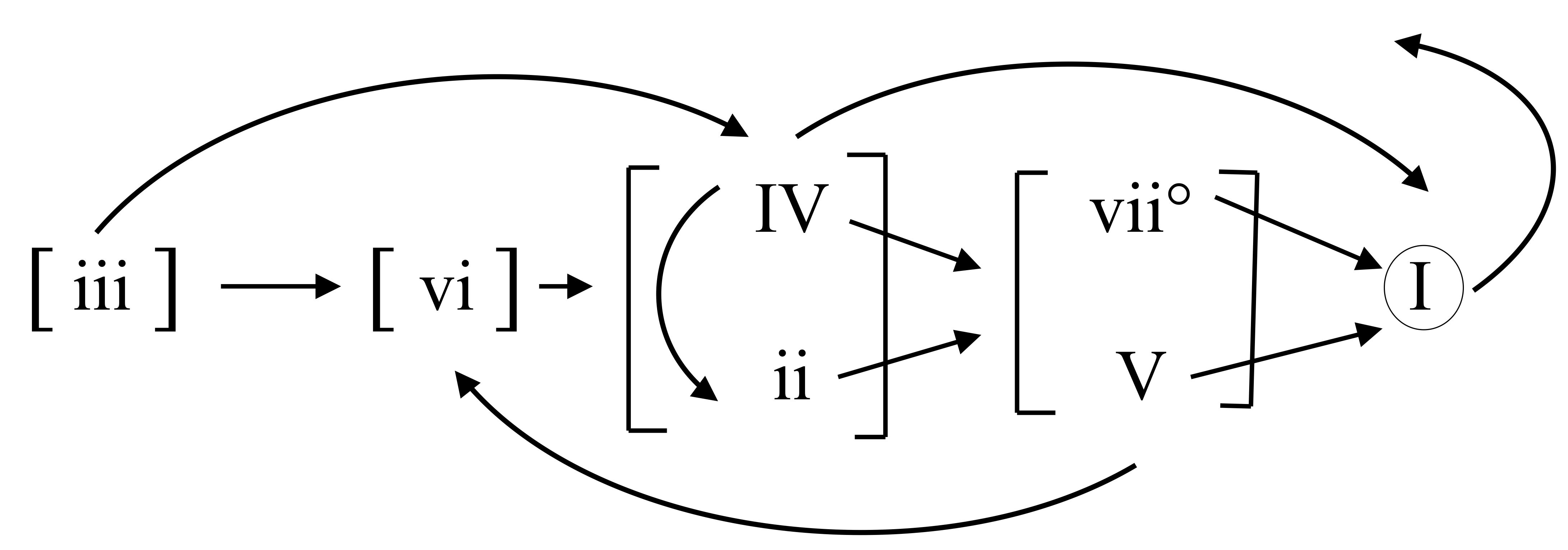
→ See the Kostka & Payne chord progression chart below for a summary of how diatonic chords usually progress in tonal music. - Try to use non-triadic constructions as well, such as quartal and quintal harmony.
→ One challenge in using these types of harmonies is that, depending on what note you start on, you might end up with accidentals if trying to maintain a vertical structure of perfect fourths, such as C - F - Bb - Eb - Ab, etc. While occasional accidentals are fine in pandiatonicism, for the most part the objective is to avoid them. They are fine if required for modulations, however.
→ If you want to write quartal harmony using only perfect fourths and white notes (i.e., no accidentals), for example, you could build up from B: B - E - A - D - G - C - F.
→ If you want to try this with quintal harmony, build up from the last note above (F): F - C - G - D - A - E - B. - Give Slonminsky's serialist diatonicism a try if you wish.
You may find it challenging to write music you enjoy without borrowing common practices from tonal music; therein lies the reason tonal music is so widely embraced: Its practices have evolved over centuries to sound good to Western ears. We talk about Ti "wanting" to rise to Do in a V-I progression, or of a chord seventh "wanting" to resolve down by step to a consonance in the next chord, or a 4 "wanting" to resolve down to 3 in a 4-3 suspension, because these practices sound good or "right" to our ears, so writing tonal music in which these practices are not followed can feel very "wrong" to us.
(On a side note, I am curious to know if the tonal music practices that sound "right" to our ears have corollaries in music of other cultures, such as South-Indian classical music, or traditional Chinese music. Do they use anything like dominant-tonic harmony?)
For this reason, you may find it easier to write pandiatonic music that avoids triadic progressions, such as Slonminsky's serialist approach to diatonicism, or pointillistic music in which widely-spaced notes are distributed in unpredictable ways.
I'll stop here for now; I will post some links to pandiatonic music in my next blog post.
Please let me know your thoughts below in the comments section!
How diatonic chords in classical music usually progress: Chord-Flow Chart (from Kostka, Stefan M., and Dorothy Payne. Tonal harmony: With an introduction to twentieth-Century music. New York etc.: McGraw-Hill, 2009. P. 111):
Check out the next post, Pandiatonicism 2, to listen to various works that some have claimed to be pandiatonic.
You may also like these posts on Post-Tonal Harmony Ideas:




 Posts
Posts


