Showing posts with label art. Show all posts

Wednesday, October 5, 2016

Post-Tonal Harmony Ideas (3)

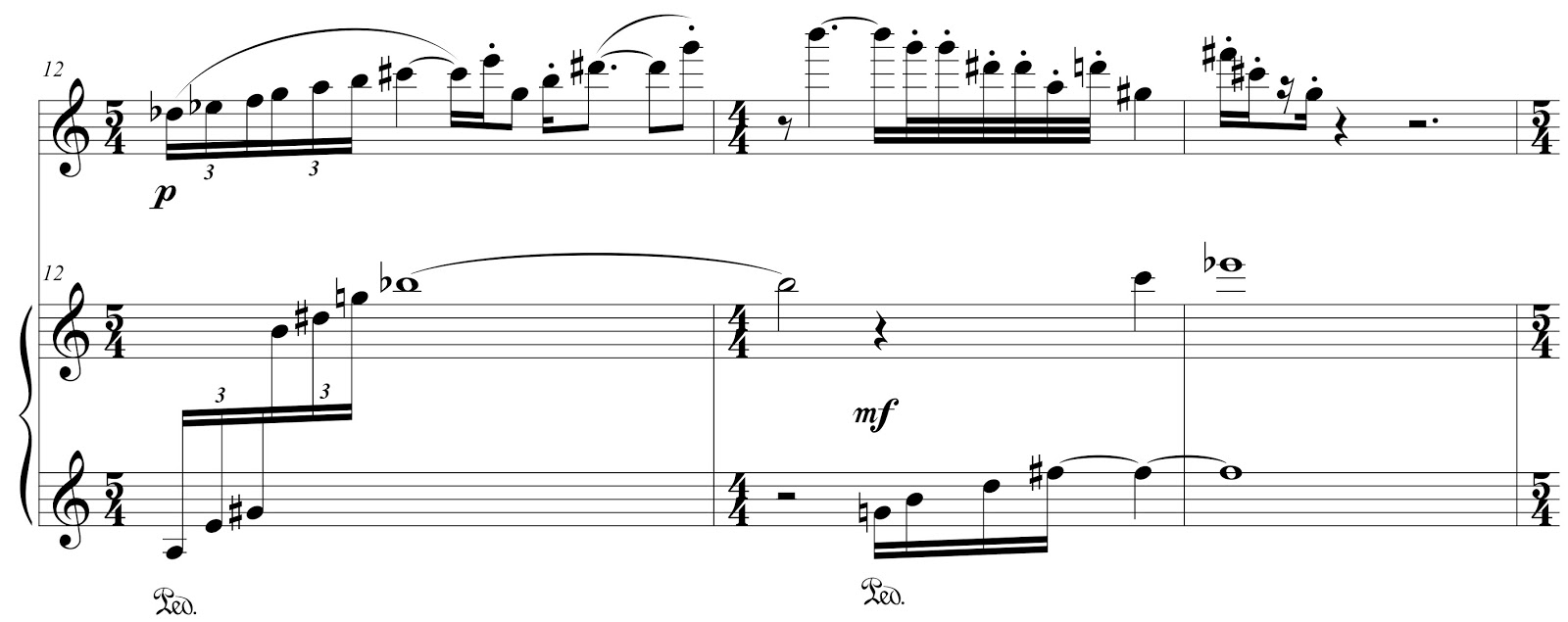
I wrote a short piece for today's post, based on the arpeggiated chords presented in section 8 of my Post-Tonal Harmony Ideas (1) post. You may wish to listen to those chords again before listening to today's composition , but it's fine to skip this and just listen to the piece below.

The chords in section 8 of Post-Tonal Harmony Ideas (1) were constructed by superimposing different harmonic structures found in tonal music, such as an F# major triad and C major triad, a combination used by Stravinsky in Petroushka, in order to create post-tonal sonorities.

There are no particular "rules" to follow in combining chords in this way, but I would suggest that the resulting sonority should not sound overtly tonal; if you start with a G chord and superimpose an F chord, for example, it would result in a G11 chord, which is overtly tonal.

That said, however, it is really the context in which such chords are used that determines whether they are tonal or post-tonal. If you play the chord in bar 3 below, for example, and resolve it to an Eb chord, it will sound like an altered V7 resolving to I in Eb major, because bar 3 starts with a Bb7 chord. If you play the same chord (bar 3) but move to a different sonority that in no way suggests an Eb chord, then you've placed it in a post-tonal context.

Another suggestion, if you try this approach, is to use chord combinations in which the two triad-based chords have no notes in common with each other, although that is by no means an essential condition.

The approach I find that works best is to work these out at a piano, exploring the possibilities by playing different chords in each hand until you find combinations you like, and then immediately write them down. Frequently, the experimentation may involve just altering one note at a time until you find a sonority that you'd like to keep.

Once you have a collection of chord combinations that you like, you can use them however you wish in a composition; you can transpose them, add further notes to them or otherwise modify them, invert them, re-use them, etc.

Here is the piece; you can hear it with the audio player below the score:


More Details on this Composition:
  • I began with the first three arpeggiated post-tonal chords presented in my Post-Tonal Harmony Ideas (1) post (they are in section 8, numbers 1, 2, and 3). 
  • I transposed the second arpeggio, and subsequently re-used and transposed the other arpeggios as well. 
  • In bar 7, I introduced a new chord (i.e., one that wasn't in the original blog post), which consisted of a Db Maj.7th chord plus an Eb Maj.7th with augmented fifth. I also reused transpositions of this chord.
  • One way to vary these chords, aside from changing notes within them, is to add notes on top of them that are not part of the original sonority; I did this a few times in this piece, especially in my choice of flute notes.
  • As you can hear, I took time in the score to move from one sonority to another, because the harmonic complexity of these chords is, to me, inherently captivating, and it takes time for the ear (well, the brain, actually) to absorb them. 
  • Harmonic progressions using these chords can proceed as quickly as you want, however.
  • This is "colour-based" composition; each chord has its own colour. The process is something like an artist creating an abstract painting using only splashes of colour here and there, with the result being pleasing to the eye (well, the brain, actually).
  • "Mystery" and "Wonder" were the names of two of our cats that passed away several years ago.
Final Thought: Practicality
  • One very practical advantage of this approach to composition is that the chords should fit naturally into the pianist's hands, provided you started by experimenting at the piano with chords that fit your hands. A skilled pianist has spent years training their hands to instantly form the correct shape in playing tonal chord structures, like triads and 7th chords, so if you use those same chord shapes, but combine them in untraditional ways, the pianist is likely to find the music easier to play than a lot of contemporary music.

Saturday, January 16, 2016

Blog Index — Organized by Topic (®Jan/2016)

Below is an index of most blogs posted thus far. Entries relating to class business – reminders of deadlines, concert congratulations, order of class presentation, etc. – are omitted.

Links are loosely organized by topic to facilitate browsing.


→ Exploring the Creative Process; Struggles and Solutions ←
Strike While the Iron is Hot! (includes section on "writer's block")

→ Planning ←

→ Playing With Expectations; Musical Dichotomies ←

→ Composition Techniques 

→ Form in Post-Tonal Music ←

→ Atonality; What's in a Name? ←


→ Winning and Losing; Judging and Being Judged ←

→ Audience Response to Contemporary Classical Music and Marketing ←

→ Composition Issues (10-part series that started this blog) ←
1.1. The quality of ideas may not matter very much in assessing compositions that emerge from them; and
1.2. The degree to which these ideas are original may not matter very much.
2.1. Study the music of others.
2.2. Compose as much as you can.
2.3. Invite criticism from others.
3.1. Live with it for a while.
3.2. What is it about?
3.3. Does it change character?
3.4. What is its function within the context of the piece?
3.5. Structural Analysis.
3.6. Harmonic (or Pitch, Scale, etc.) Analysis.
7.1. Less is more / More is more
7.2. Always leave them wanting more / Give them what they want
7.3. Don't treat the listener like an idiot / There's a sucker born every minute
7.4. There can be too much of a good thing / If you have a good idea, then stick with it!
7.5. The George Costanza approach.
8.1. Three models for the role of a composer
8.2. Mastery or Mystery?
8.3. The value of a plan
8.4. Getting stuck, and possible workarounds
8.5. Don't obsess
8.6. Challenges = Opportunities

→ Composition Projects ←

Thursday, November 11, 2010

The Ross (née Heisenberg) Uncertainty Principle, and Other Musical Dichotomies

Most readers of this blog are, I am sure, well acquainted with the Heisenberg uncertainty principle, the gist of which is that there are certain pairs of physical properties in quantum mechanics (e.g., position and momentum) where the more precisely one is measured, the less precisely the other can be measured, represented as follows:


As every musician knows, the uncertainty principle can be applied to Fourier transforms of complex waveforms:


Now, you may be saying, "Not so fast, cowboy!  I am not at all acquainted with Heisenberg's uncertainty principle (nor, I suspect, are most most readers of this blog!), and all of these mathematical formulae are making my head spin!  Besides, what does any of this have to do with musical composition?"

I will respond by admitting that  (i) I am not actually a cowboy, and (ii) my opening statements are mischievous attempts to be provocative (or vice versa; I'm not really sure).  I realize that Heisenberg and complex mathematical equations are not common areas of study for most musicians, but, whether you understand them or not, those equations certainly catch the eye, do they not? ;)  In any event, please do not worry; there will only be one further mathematical equation in this blog, but I will explain it with disturbing clarity, or concise obfuscation, depending on my mood at the time.  Or not…


One of the most important dichotomies to be found in most classical music is certainty versus uncertainty; today's blog is about the value of uncertainty, in a very general sense, within musical compositions.

Here are some examples of how this can work:

Certainty
Uncertainty
Themea recognizable melodic idea.
Development; use of familiar motives in unfamiliar contexts; transformation of motives in order to create new material.  Some aspects of the material may be recognizable, but the listener may be unsure as to where it is going.
Transition; the beginning of a transition often sounds like a continuation or repetition of previous thematic material, but it soon becomes apparent that something different is going on, as  modulation takes place, and the material is taken in a different direction, creating uncertainty.
Key/Modality/Pitch Center; a section is in a particular key, or modality, or, if non-tonal, it may be centered on a particular pitch class.
What key are we in?  Development sections, transitions and retransitions, cadenzas, and even some coda sections (notably Beethoven's) all move between key areas, creating harmonic instability.  Even tonicizations within more stable key areas can create some harmonic uncertainty.  
Form; I recognize this form! I therefore have a pretty good sense of what is likely to happen next. If the form includes a recapitulation (and most do), then I have a very good sense of what to expect for the last section of the piece.
Form? Um... What's going on here? I don't recognize the form.  Or, I thought I recognized the form, but the composer has thrown in unexpected elements (such as a coda that is longer than the development, or an unusually long transition, or a cadenza thrown into a piano sonata (as in Mozart's K.333, III), or a new theme in the development section).  Is it sonata form, or rondo, or sonata rondo, or sui generis, etc.?

My musical "uncertainty principle" is this: It is at least as important to have sections that give rise to a sense of uncertainty in a composition as it is to have sections of certainty. 


Fortunately, this can be represented by the following equation, which makes composing extraordinarily easy (if you're a physicist); x = quantity of uncertainty (measured in photon energy), p = mass of uncertainty (e.g., any Mass movement, such as kyrie, gloria, credo, etc.), and the h-bar is, of course, Planck's constant (I'm guessing this is a reference to Planck's faithful canine companion, Helmut):


Why?  The excitement of a roller-coaster ride — not an emotional one, an actual one! — is probably related to both the ascents and descents; going up the big hill that tends to be right at the start creates a sense of Heisenbergian uncertainty (some might call it "dread"), as you wonder what lies in store for you once you reach the top (Is this thing safe?  Why did I think this would be fun? Do I have a legal will?), and going down creates a sense of certainty (I am going to die! I know it for sure! Whee!), mixed with uncertainty (how much longer? Why is it so dark in here? Will I toss my cookies?).  People who love these rides, I would guess, love both the uncertainty and the certainty of the experience, but especially the former.  At least I do...

But a musical composition isn't a roller-coaster ride, is it?

Well, perhaps not, but I was making a rather loose analogy.  A musical composition can be compared to a journey, and, if this analogy makes sense to you, then it is a wonderful example of the old saying that what matters most in life is the journey, not the destination. How much fun would life be if you knew exactly what was going to happen at every stage?  How enjoyable would a musical composition be if you knew beforehand exactly what would happen at every stage?


Uncertainty; don't leave home without it!

What about compositions that are memorized?  They are enjoyable, even when I know exactly what will happen next!  Good point!  But I think what may be taking place here is that even when you know exactly what notes are going to be played before they are actually played, I am not sure that you know exactly what your emotional response to those notes will be, so here again, I suspect that part of the attraction to the composition may be based on uncertainty.  This too is analogous to a roller-coaster ride; even if you've been on it numerous times, you might respond slightly differently to it each ride.

I encourage you to look for opportunities within your compositions to try this idea out.


This topic is an offshoot of the predictability/unpredictability dichotomy that I have mentioned in class and written about in past blogs. Predictability within a musical composition, like routines in life, can be comforting and reassuring at times, but too much can quickly bore the listener; a great composition seems to have a perfect balance of the two.

Below are links to two blog entries relating to this one, FYI:

• Two musical dichotomies: Familiar vs. Unfamiliar, and Expected vs. Unexpected
• More musical dichotomies


Questions:

1. Besides those already discussed, to what other musical parameters can this certainty/uncertainty dichotomy be applied?

2. What are some of the ways in which it can be applied to the composition on which you are currently working?

3. Is this a useful way to think about music?

4. What are some other dichotomies to be found in music?

5. Can the certainty/uncertainty dichotomy be applied to other genres of music, such as popular, jazz, folk, or world?

Friday, March 5, 2010

Marketing Modern Music (2)

The second article I linked to last week was "Looking for Listeners Who Love New Music" (New York Times, February 28, 1999), by Greg Sandow, who composes, has taught "Music Criticism," and "Classical Music in an Age of Pop" at the Juilliard School. and has written on classical music for The Wall Street Journal and other publications.

The subheading of Mr. Sandow's article is, "There really is an alternative new music audience, one that's hardly connected to classical music at all."

Sandow suggests that part of the challenge in getting mainstream classical music fans to embrace new classical music is that the product (new classical music) is being marketed to an audience whose stylistic preferences lie elsewhere (18th- and 19th-century music). The problem isn't with the product; the problem is in the way it is marketed.

As an analogy, consider what would happen if someone decided to market "adult contemporary" pop ballad singers (e.g., Céline Dion, Lionel Richie) to fans of death metal, gangsta rap, or screamo, or vice-versa, using the logic that fans of one sub-genre of pop music (e.g., death metal) are bound to like all other pop sub-genres (e.g., adult contemporary). It would seem a strategy unlikely to succeed; just because you like one sub-genre of pop music doesn't mean you necessarily also like all the others. The marketing principle, in a nutshell, is that it makes more sense to target your product to people who would be interested in it than to those who would not.

Sandow:  Let's say you're in business, and you've got a product that your customers love (in the Philharmonic's case, Beethoven and the other classical masters). Now you've produced something much less comforting, and more esoteric. Would you try to sell it to the same people?

Or think of the pop-music world, where it's taken for granted that audiences come in many flavors. There's a mainstream audience, which loves Top 40 ballads, and there's an alternative audience, which prefers darker, edgier, more difficult music, by artists like PJ Harvey and R.E.M. Is there a lesson here for classical music? Is there an alternative classical audience that can be reached in some new way?

The answer, according to Sandow, is a resounding yes. As an example of such an audience, Sandow cites "Bang on a Can," which draws 1,000 people to its annual new-music marathons, and these, said its director of development, Christine Williams, are in their 20's and 30's, attracted in part by aggressive marketing aimed at lovers of downtown dance, jazz, visual art and performance art.

Another example mentioned is Milwaukee's "Present Music:" "You can look down from the stage, and see the earrings and nose rings and different- colored hair," said its director, Kevin Stalheim. "If I were going for mailing lists, I'd go to the art museum and modern dance companies, not the Milwaukee Symphony."

If you want proof that is closer to home of an alternative new-music audience, you need go no further than the biennial Newfoundland Sound Symposium, known around the world as a kind of sonic Mecca for new-music enthusiasts. There is some overlap between its audiences and, say, Newfoundland Symphony Orchestra subscribers, but my hunch, having attended both numerous times, is that the overlap is probably not very large; both have their own devoted followers, and just because you like one doesn't mean you will like the other.

So, does this mean it is impossible to get people who love Beethoven and Brahms to open their hearts to new classical music?

I don't believe so, nor is the article's author suggesting as much. Some mainstream concert presenters seem to have succeeded in doing so, such as the Los Angeles Philharmonic, the Lyric Opera of Chicago, and the San Francisco Symphony, according to Sandow. A lot of new classical music is very much rooted in old classical music, and it isn't unreasonable to think that there can be audiences that enjoy both.

On the other hand, there is also a lot of new classical music that seems to fall outside the comfort zone of many Beethoven/Brahms/et al. lovers, and perhaps it is unreasonable to expect otherwise.

The "elephant in the room" that hasn't been mentioned in this discussion is that a great many orchestras find themselves in crisis: Most are losing money, and are not attracting enough new, younger, patrons to counteract their steadily aging and shrinking audiences. As a result, some have gone bankrupt — in this country, this has happened to the orchestras in Halifax, Hamilton, and Vancouver, although all were subsequently resuscitated — and others teeter on the edge of bankruptcy. The CBC cited financial reasons for shutting down its radio orchestra, although some see it as part of their overall shift away from supporting classical music (which, in the case of CBC Radio 2 has resulted in a drastic reduction of their audience share, as I understand it). Fortunately, the National Broadcast Orchestra of Canada has arisen in its staid without any financial support from the CBC, and as I understand it, part of the NBOC's mandate is to programme contemporary works by Canadian composers. I hope they will thrive as an orchestra.

In an effort to grow their audiences, many orchestras offer "pops" programmes, film music programmes, and programming hybrids wherein rock bands and rap artists perform with a symphony. I would guess that some of these initiatives are financially successful, but I don't know the degree to which they create a new or larger audience for either more mainstream or contemporary classical music. Hopefully they do.

The solution seems quite simple to me: Programme more of my music! Audiences of all ages, hair colours, and body-piercing preferences love the stuff.

No? Well, that statement was made half in jest, but only half, because I would like to think that the solution lies at least in part in reaching out to audiences that are attracted to newer, often more experimental art by offering programmes targeting these audiences. But I recognize that it's a kind of logical paradox (A.K.A. Catch 22) wherein many who are attracted to the work of living artists think of symphony orchestras as musical art museums exhibiting the work of dead artists, and so programmes aimed at fans of contemporary art might not actually attract them, and may in fact alienate some of the orchestra patrons who prefer their art to be by composers who are mostly European and entirely dead.

One thing I have discovered is that you don't have to be a fan of classical music to enjoy contemporary classical music.  A few years ago, I started posting my music at MacJams.com, an on-line community of thousands of music-makers of all kinds, probably mostly falling within the various sub-genres of pop/rock, but also including other genres such as jazz and classical.  I have read many favorable comments about contemporary classical pieces by people who admit that they don't know or even like much about classical music, which I thought was pretty cool and reinforced my hunch that more people would like this music if they were exposed to it. If you are curious to read some of these comments, have a look at my Dream Dance page, or just go to the site's "classical" category and see what you get.

And so, in agreement with the Sandow article, it has also been my experience that there is an alternative new-music audience, but the challenge for contemporary composers is to find a way to reach them.

Monday, February 22, 2010

Marketing Contemporary Music (1)

More food for thought: Marketing Contemporary Music (article by Greg Sandow in the New York TImes; click link to view entire article).

The following is taken from the end of Mr. Sandow's article. Please read and leave a comment below, if this topic interests you:

… There really is an alternative new-music audience, one that is hardly connected to classical music at all.
     The beacon for this view of contemporary music would be Bang on a Can, a sharply informal New York group that is presented by Lincoln Center (and might even play thoroughly classical music by Elliott Carter), but does not look, feel, taste or smell like a classical institution, and in fact refuses to think of itself as part of the classical-music world. It draws 1,000 people to its annual new-music marathons, and these, said its director of development, Christine Williams, are in their 20's and 30's, attracted in part by aggressive marketing aimed at lovers of downtown dance, jazz, visual art and performance art.
     In Milwaukee, an enterprising contemporary group, Present Music -- which gets up to 700 people at some of its events and impressively sells more than 200 subscriptions to its six-concert season -- has a similar philosophy. "You can look down from the stage, and see the earrings and nose rings and different- colored hair," said its director, Kevin Stalheim. "If I were going for mailing lists, I'd go to the art museum and modern dance companies, not the Milwaukee Symphony."
     Present Music plays more traditional programs than Bang on a Can, ranging from mildly alternative composers like Henryk Gorecki and Steve Reich to mainstream stalwarts like Joseph Schwantner and Harrison Birtwistle. Why doesn't New York's alternative audience -- the people, for instance, who enjoy going to the Brooklyn Academy of Music -- come to hear similar programs at Carnegie Hall?
     One big part of the answer is presentation. "We did a piece with black light, and we threw Ping-Pong balls around in the audience" Mr. Stalheim said. "We start our season like opening day at the ballpark, and maybe we'll play 'The Star-Spangled Banner' on a theremin. We try to end our concerts with parties." This is not selling out, Mr. Stahlheim insists, because most of the time the group is serious. But it gives his concerts good press and makes them fun.
     Nonesuch Records cultivates its own version of this alternative audience, and has done wonderfully, sometimes selling more than 100,000 copies of CD's by Steve Reich, Philip Glass, Astor Piazzola and the Kronos Quartet, and only slightly less of John Adams. This, says Robert Hurwitz, who runs the label, is a market that was already there, one that overlaps with the classical-music audience but is also distinct from it, and which Nonesuch's vice president of marketing, Peter Clancy, described as "people open to the new, different and unusual, who seek out world music, modern and ethnic dance, and performance art." This, perhaps, is a contemporary version of the "intellectual audience" Virgil Thomson identified among classical-music listeners in New York in the 1940's, and the success of Nonesuch suggests that it might be bigger, at least potentially, than anybody thinks.
     Can mainstream classical-music institutions attract these people? The enterprising Albany Symphony has placed composers in elementary and high schools and also presents an alternative new-music ensemble -- the Dogs of Desire -- at local colleges, thus using contemporary music to give the orchestra new roots in its community.
     Mr. Wyjnbergen, of the Los Angeles Philharmonic, thinks he might present new music in "rock clubs, art galleries or an old factory that has been rigged up." He doesn't expect to attract younger people to the orchestra's existing programs, but instead hopes to include them by extending the Philharmonic's reach. He also identifies another "niche audience" for contemporary music, made up of "visual people, architects, painters, photographers and graphic artists." These, he thinks, he can attract by asking 40 of them to create visual impressions of contemporary musical works.
     Mr. Pastreich, too, says he has tapped an alternative crowd when the San Francisco Symphony presents "maverick" composers like Lou Harrison or Meredith Monk. And while he says that 90 percent of his new-music listeners are drawn from his regular audience, he also notes that younger people are now buying tickets, thanks to the informality and commitment of Michael Tilson Thomas.
     Should we be trying to educate the classical music audience, as my colleague so strongly urged? Why talk as if there's something wrong with it, as if it has a disease that needs curing? Instead, let's arouse it, excite it and draw new people to new kinds of artistic musical events. That way, even large institutions might renew themselves and heal the split between contemporary classical music and the rest of the arts.


What do you think?
_____________________

If you like Mr. Sandow's writing, please check out some of the many links to his other articles on his home page.
_____________________

See my next post, Marketing Contemporary Music (2) for my thoughts on this topic.
_____________________

UPDATE: Both links above have been fixed (Jan, 2023).  I also considerably expanded the portion of Mr. Sandow's original article quoted above.

Wednesday, July 15, 2009

Is Originality a Detriment in Art?

I think originality is an essential element in art, but in my previous entry I suggested that there are many examples of great art in which the degree of originality is arguably not very high, but this does not seem to detract from the value of this art, or its impact on us.

Today I will go a step further and suggest that originality, and the power of art to move us, may exist in a kind of inverse relationship; that is, a groundbreaking, highly original work of art may be less likely to move us than a work that uses techniques and conventions with which we are familiar, albeit in a somewhat original way. Or, put another way, if someone makes up a beautiful poem in Klingon language, most of us are unlikely to be moved by it unless we know Klingon. Which, alas, I do not.

But first an explanation of why this topic interests me.

I [used to] post my music at MacJams.com, a site where anyone can could upload their music for the purposes of getting feedback from others. I liked it a lot; it is was a very welcoming to people who make the effort to be involved, which I suspect is true of all on-line communities. [MacJams ceased to exist around 2015. ]

In addition to written comments, you can could also vote on others’ music (although some artists chose to disable this option for their submissions, preferring to receive comments only and not votes). The voting system goes from 1 to 10 in four categories, one of which is “originality/creativity,” which is explained as follows: “Has this artist created something unique or pushed the musical boundaries?”

The answer to this question is clearly “no” for every piece I have ever heard there, including my own music, if one understands “unique” to mean "highly unusual or rare," "the single one of its kind," or "radically distinctive and without equal" (definitions I found at OneLook.com). Fear not, gentle reader; I do did not therefore go around MacJams giving scores of “1” in this category. I do did what I suspect most voters do did; I give gave high scores to music that doesn’t didn't sound too much like a blatant rip-off of something else, and medium scores to music that does did. Being Canadian, my genetics prevent prevented me from giving low scores.

In any event, the existence of this voting category at MacJams got me thinking about the meaning of “originality/creativity” (which I see as two separate categories, by the way, but that is a discussion for another day) and the importance of originality in the evaluation or creation of art.

Other reasons that this topic interests me are that (a) I am a composer, and it’s an issue that is on my mind whenever I write music, and (b) I am a composition teacher, and an idea that I try to communicate to students is that being overly concerned with the originality of one's creations may be dangerous, because it can lead to extreme self-censorship, i.e., not continuing any musical ideas because, upon reflection, they are not original enough.

On the other hand, it seems to me that at least some originality is essential if one does not wish to write music that sounds too much like somebody else's. As with so many other things in life, it comes down to a question of balance.

And so, to answer the question posed in today's blog entry, originality, by which I mean the quality of uniqueness, being significantly unlike anything else that exists, can be a detriment in art if one of the goals of the artist is to express something that others can understand. In spite of this, it is an essential aspect of art. Perhaps it can be said that a little goes a long way, but too little goes nowhere at all!

Wednesday, July 8, 2009

How Important is Originality in Art?

I think many people would suggest that originality is an essential ingredient in art. As an example, an excellent copy of the Mona Lisa, virtually indistinguishable from the original, might be valued at a few hundred (or a few thousand) dollars, whereas if the actual Mona Lisa is as close to priceless as is possible for a painting. Two identical works of art; one original and iconic, the other a reproduction, but the first is much more highly-valued than the second by virtue of its originality.

This looks like the Mona Lisa; the actual painting, however, is in the Louvre behind bullet-proof glass.

But there are cases where a lack of originality seems less crucial to the value ascribed to a work of art. Many artists have created numerous variants of the same, or similar, things — consider Monet's approximately 250 paintings of water lilies (as well as his series of paintings of Poplars, Haystacks, Rouen Cathedral, Mornings on the Seine, and the London Houses of Parliament), Degas' extraordinary penchant for dancers as a subject (more than half of his vast output of paintings, drawings, and sculptures is devoted to the activities of the ballet dancers and dance students), or Georgia O'Keefe's paintings of flowers — all highly regarded, but, thematically, not particularly original.


Two of the 19 paintings from Monet's "The Houses of Parliament" series. All are the same size, and from the same perspective, but show changes in lighting and hue at different times of day, and in different weather conditions.

If you enjoy visiting art museums, there is a reasonable chance you may have seen Rodin's "The Thinker," his most famous work, and one of the most-recognized (and most-satirized) sculptures ever. The original was 27.5 inches high, but there are over 20 additional casts of the work in various sizes, most of which were executed by his apprentices, as I understand it. Their lack of originality does not prevent them from being prominently displayed (and hence valued) in museums around the world.

"The Thinker," Rodin. At least 20 casts were made of this sculpture.

The paintings in Monet’s Houses of Parliament series are similar – each is of the same subject, viewed from the same vantage point, and on the same size canvas -- and dissimilar – each view represents a different time of day (which alters the lighting), and different atmospheric conditions (hazy, foggy (or smoggy), and different cloud formations). The point, as it relates to originality, is that Monet did not attempt to paint a series of completely different (and therefore highly original) paintings; he wanted to paint the same thing repeatedly in slightly different ways, and we value each individual painting highly nonetheless.

These examples, and many others, suggest that the role of originality in evaluating art may sometimes be relatively minor.

Stravinsky is supposed to have said “good composers borrow, great composers steal,” [ 1 ] which is itself an adaptation (or theft?!) of T. S. Elliott’s “Immature poets imitate; mature poets steal,” from Elliott's essay on English dramatist Phillip Massinger (1920). It is a clever line, the merits of which are of course debatable, but for me the point is that artists frequently influence one another; part of the way many artists discover their own voices is by emulating, or appropriating, to varying degrees, aspects of the work of others.

Music is filled with elements common to different composers within an historical period, and sometimes across periods. When we study tonal harmony, we learn that in the "common-practice period" (roughly 1700-1900, in Europe), there were guidelines governing the way in which chords progressed. These guidelines have numerous restrictions as well as some freedoms, but the fact that there are guidelines of any sort means that originality in chord progressions was not highly valued.

Composers in the "common-practice" period made widespread use of a limited selection of musical forms, chief among them sonata form, as well as rondo, binary, ternary, and theme and variations. When we study sonata form, we marvel at the many nuanced differences we find in different compositions, even though the big picture form is the same. Other common elements include the use of Alberti bass accompaniment figures (although it had numerous variants), an extremely-limited selection of cadence types (virtually every composition from that period ended with an 'authentic' (V-I) cadence), common phrase lengths (especially 4-bar phrases) and phrase-structures (although numerous exceptions can be found), and writing for commonly-found ensembles such as the string quartet.

And yet, despite the restrictive nature of these common elements, thousands of wonderful works were written. There is originality to be found in all great (or even good!) works to be sure, but, as with Monet’s parliament paintings, the differences are often fairly nuanced.


1 Although there are numerous attributions of this quote to Stravinsky all over the web, I have not come across any that cite a source for it. It seems entirely possible that he said this, but I would like to find out if he actually said or wrote this… If anyone has a citation for this quote, please let me know. Of course, it might also be a sentiment that hacks the world over like to attribute to a famous composer in order to justify theft of intellectual property.

Originality — Does it have any role in art?

Compare these two songs (you may have to wait a few seconds until they load):

MPHO: "Box N Locks"

Martha and the Muffins: "Echo Beach"

Someone posted the first of the above videos in a forum thread on MacJams.com, a now-defunct site where musicians gave each other feedback on their musical creations, and the title of the thread was "Lazy Songwriting."

The artist in the first video, MPHO ("pron. MM'POH") sings a song over the start of the instrumental tracks from Martha and the Muffins 1980 hit, Echo Beach (the second video above). MPHO uses different lyrics and a different melody, and there are a few other differences, but it would appear that a substantial portion of MPHO's song uses the actual instrumental tracks from Echo Beach, or instrumental tracks that are so close to the original as to be indistinguishable from it.

The issue is this: Is this lack of originality in "Box N Locks" (the title of the MPHO song) problematic, perhaps to the point of dismissing MPHO as a plagiarist, or do we applaud the creativity of MPHO in taking tracks from an existing song and coming up with a new treatment?

(Let us assume, by the way, that MPHO has acknowledged the debt her song has to Echo Beach, and that the owners of Echo Beach are receiving the royalties due them from MPHO's treatment of their instrumental tracks. I do not know if this is actually the case or not, but I am more interested in the ethical issues here than I am in the legal ones.)

Now, before we get too caught up in questioning the ethics of "Box N Locks," consider the following:


(Incidentally, the above video is itself based on a pretty famous YouTube video called "4 chords, 36 songs," so the idea for this video on unoriginality is itself unoriginal.)

… In case you were not willing to listen all the way to the end of the previous video, the gist is that it plays excerpts of 65 pop songs that all use the same four-chord progression: I-V-vi-IV (in the key of C, this would be C-G-Am-F, usually repeated frequently). The list is hardly exhaustive; there are many more songs that could be added to that list.

There are numerous other oft-used chord progressions in songs too, like I-vi-IV-V (e.g., C Am F G), and the ever-popular I-IV-V (e.g., C F G), or I-IV-V-IV (C F G F), or I-V-IV (C G F), I-iii-IV C Em F), etc.

When I was a jazz guitar student, my teacher gave me a chord progression to learn for improvisation practice called "Rhythm Changes." After a few weeks, it occurred to me to ask about the origin of the name, and he told me that the chord progression came from the 1930 Gershwin song,  I Got Rhythm, but it has been used in hundreds other songs as well. The Wikipedia article on this progression calls it "ubiquitous" in jazz music, and adds that by writing a new melody over its chord changes, thereby creating a composition of a type known as a contrafact, a jazz musician could claim copyright to the new melody rather than acknowledge Gershwin's inspiration and pay royalties to his estate.  [Read more about it here if you like.]

Tunes and lyrics can be copyrighted, but chord progressions can't.  If a songwriter's objective is to write a "hit," it would be virtually impossible to write a chord progression in which large portions have not previously been used in various other songs, and copyright law reflects this. Thus, when it comes to chord progressions, originality does not play a very large role in many musical genres (pop, blues, folk, jazz).

There are, of course, exceptions; I don't think the chord progression in John Coltrane's "Giant Steps" had been used before the 1960 release of the album of the same name, but many have used this chord progression for other songs since then, to the extent that jazz musicians refer to it as Coltrane changes. If you aspire to be a jazz musician, you pretty much have to learn to play and improvise over this in every key (and at a break-neck tempo!).


The title of this post — "Originality - Does it have any role in art?" — is mostly tongue-in-cheek; I suspect that most would consider it to play an essential role in art, but, as I have suggested elsewhere (see my next blog entry), its importance may be overrated. 

If I were a pop musician and, in the course of writing a song, discovered that my chord progression was one that someone else had used, it would seem foolish (or at least impractical) to conclude that I ought not to continue writing that song because of its lack of originality. I suspect that the odds would be extremely slim that most songwriters could ever come up with a truly original chord progression while remaining rooted in the functional tonality used by virtually all pop songs.

If you concern yourself too much with the challenge of creating a truly-original chord progression in pop music, you might find it very difficult to finish a song. On the other hand, if everything you wrote sounded very much like the music of others, you might have a hard time carving out a niche for yourself that distinguished you from others. But would this would stand in the way of establishing a successful career in pop music? I doubt it.

I would argue that originality has an essential role in art, but it can be an impediment to the creative flow for an artist to become overly concerned with it (as I have written in another blog), and so perhaps the most practical approach would be to focus primarily on writing the music you want to hear, but with at least some awareness of the need to make that music personal, thereby distinguishing it from the music of others.

And if by "original" we mean "completely unlike anything that has been composed before," we would be hard-pressed to come up with truly original music, and if we did, it seems likely that it would be so strange that few could relate to it. Incidentally, I would never suggest that you "shouldn't" write original/unusual music for this reason; write what you would like to hear, and if it is highly bizarre, so be it!


I listened to a YouTube video several months ago of a Beatles rehearsal of "I'm So Tired," a John Lennon song, from the "white" (i.e., untitled, except for the group name) album, where Paul was singing the tune in a goofy kind of way, but what struck me most about it was that the chord progression that McCartney played in the first line of the song was I-vi-IV-V — a ubiquitous progression in 1950's "Doo-Wop" music — whereas in the album version (sung by John), the second chord is VII (yup, a major chord built on the leading tone). A small thing, perhaps, but the use of the VII chord is highly-unconventional, and gives the song a significantly-different feel:


One of the things that makes Beatles songs so musically compelling for me is the occasional use of unexpected chords, while not going so far beyond expected conventions as to alienate listeners.

Here is the album version, where the second chord in verses is (usually) a major VII:


DIGRESSION ALERT!  Incidentally, "Sexy Sadie," another Lennon song from the "white" album, also starts with a I (G) and moves to major VII (F#) for the second chord, but the third chord is iii (thus it's G - F# - Bm), which makes the second chord a V of iii:
G - F# - Bm - C - D     Sexy Sadie, what have you done? You've made a fool of everyone,
G - F# - C -D               You've made a fool of everyone,
G - F# - F -D                Sexy Sadie, what have you done? 
There is nothing particularly unusual about a secondary dominant (V of iii), but in the second line above, the VII (F#) chord is not a secondary dominant: G - F# - C -D; following a major VII with a IV is quite unusual (extremely so in classical music!). 
Continuing, the third line above begins with: G - F# - F - D, which is another unusual progression (particularly the first three chords of I - VII - bVII - V). 
The chord progression in each line is similar, but varied slightly and unexpectely each time, and it avoids the ubiquitous Doo-Wop progression that could have been used.


To conclude, borrowing is integral to many musical traditions, perhaps all of them. One manifestation is the re-use of chord progressions as discussed above, or in a standard 12-bar blues progression and its many variants. In jazz, playing standards — albeit in your own, somewhat original way — is a common practice. This is also true of folk music.

And the practice is not confined to borrowing chord progressions; other examples include:

  • Melodies; despite the fact that they can be copyrighted, melodic phrases, fragments, and ornaments are frequently re-used.  
  • I understand that in rap and hip-hop music it is common to borrow (i.e., appropriate) "beats" and entire sampled sections of other songs. 
  • Along similar lines, a very popular YouTube video is on the "Amen Break," a drum fill used in countless R and B and rock songs. 
  • Classical music uses a relatively small selection of cadence formulas, as well as numerous other commonly-used progressions, accompaniment patterns, devices (such as sequences), and textures.

Of course originality matters — I become annoyed when I hear something that sounds like a blatant rip-off of something else —but a little bit can go a long way, and obsessing over it can be a creativity-killer. So don't!  ;)


BONUS COVERAGE! Here are two more videos:

→ De La Soul - "Me Myself And I" (1989)
 

 → Funkadelic - "(Not Just) Knee Deep" (1979)


Commentary from Wikipedia:

["Not Just) Knee Deep"] is considered a classic by many and has been heavily sampled by many artists. Hip hop group De La Soul sampled the intro to the song in their hit "Me, Myself, and I", which reached #34 on the Billboard Pop Charts and #1 on the R and B Charts.

Also LL Cool J ("Nitro"), Above The Law ("Never Missin A Beat"), Tone Loc ("Funky Cold Medina"), MC Hammer & Deion Sanders ("Straight to My Feet") and Snoop Dogg ("Who Am I (What's My Name)?"), G-Funk Intro and his unreleased track "Do U Remember". Geto Boys sampled the intro for "Homie Don't Play That". Dr. Dre also sampled the baseline beat for his song "Dre Day". The Black Eyed Peas also used the beat behind it to remix their hit single "Shut Up". X-Clan sampled the song in Funkin' Lesson. It was also interpolated in the song "Get Away" by Bobby Brown.


POSTSCRIPT:

There is a long tradition of borrowing in art. 

While borrowing musical material is often associated with hip-hop music, the practice has gone on for centuries according to this article: From J.C. Bach to Hip Hop: Musical Borrowing, Copyright and Cultural Context, by Olufunmilayo B. Arewa. 

There is an article in the New Grove Dictionary of Music called "Borrowing." There is also an article in Grove on "Collage," (this is a link to a Wikipedia article on the topic), a technique found in some contemporary classical works in the 1960's, which can also be found in earlier and subsequent periods. Other musical genres associated with musical borrowing include "Plunderphonics," "Musique Concrète," "Sampling," and "Mashups." 

Then there are quotes such as these:

Lesser artists borrow, great artists steal (attributed to Stravinsky)
Good artists copy, great artists steal (attributed to Picasso)

Each of these clever aphorisms appears to be a theft of the other, and I highly doubt that Picasso or Stravinsky were the first to make these comments.

For what it's worth, there is much misattribution on Internet sites that collect quotations.