Wednesday, December 4, 2024

The Influence of Visual Art on Composers – Guest Post by Kaitlin White

Many of my mentors and peers know that I love visual art and that I grew up drawing and painting in addition to playing piano. I almost always knew that I wanted to pursue music and become a composer, hence my decision to not go to art school, but since I started my BMus degree I have had fewer opportunities to create or immerse myself in visual art than was previously the case, and when I reached my third year I was beginning to realize how much I missed it. Since then, I started looking for pieces of art that were new to me while researching the ones I knew already to develop my understanding of them, which eventually got me thinking of how I might be able to incorporate my love of art into my compositional practices. As a result, I have changed how I write, listen and think about music.

Initially, I started looking at visual art differently; in addition to marvelling at a given work, I wondered what sounds would enhance the experience of looking at a particular piece of art. I then started researching composers who have have done something similar. I did not find very much information on composers writing music based on artwork and how they went about it, but I did learn that Debussy’s “La Mer” was based on Hokusai’s “The Great Wave of Kanagawa” and how he translated some of the elements in Hokusai’s work to music (more cool information on that here:


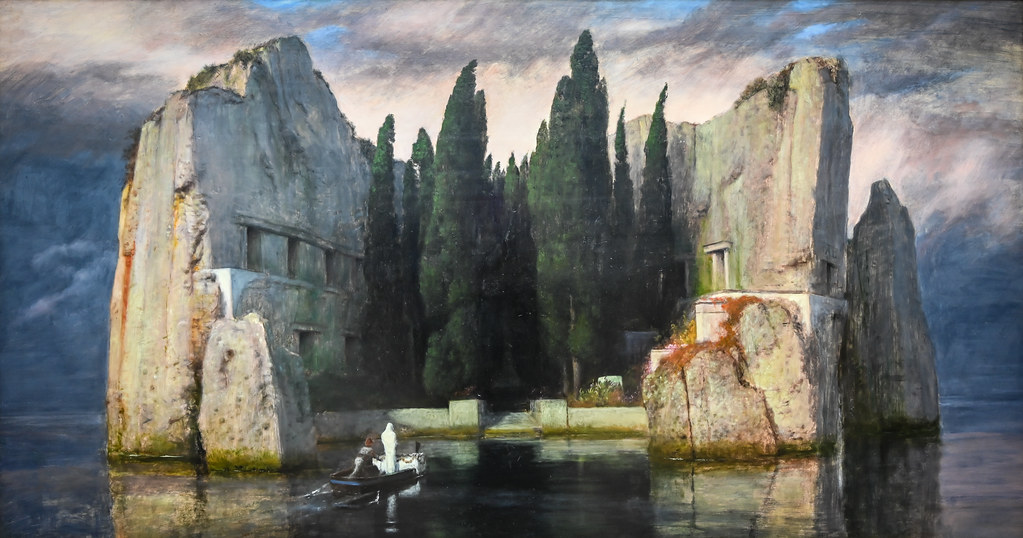
One of my favourite pieces is Rachmaninoff’s Symphonic Poem, “Isle of the Dead, which was based on Brocklin’s work of the same name. The single-movement piece functions similarly to how I feel my work progresses, meaning it seems that Rachmaninoff saw the painting like it was a single shot in a movie and told the rest of the story he interpreted the painting to tell through his music. When Rachmaninoff saw this work for the first time, it was in black and white and was disappointed to find that the original was in colour. He later stated that had he seen the original first, he would not have written the piece.
   

Other Classical pieces that were inspired by art include “Danse Macabre” by Camille Saint-Saens, “Boticelli Tryptych” by Ottorino Respighi, and “Pictures at an Exhibition” by Modest Mussorgsky.

I think the idea of basing a compositional work on art extends beyond writing music inspired by pre-existing works. Shapes and colour are the two most basic elements in any piece of visual art and coming up with a conceptual arrangement of shapes and colours is equally valid as writing music based on a physical piece of art. Some composers experienced seeing shapes and colour while hearing music to various degrees including but not limited to Scriabin and Messiaen. They would frequently let their synesthetic sensations guide them in their compositional process; what keys they wrote in, what chords they used, etc. Most people don’t have synesthesia, but I think entertaining a frame of mind like that can be valuable to performers performing graphic scores. Here is another source that goes more in-depth about Messiaen’s experience with shape and colour.
 
I highly recommend exploring this topic more and maybe incorporating other art forms somehow into your work and see how it influences what you create. If you haven’t listened to these works yet, I encourage you to listen while looking at the artwork each piece is based on to see if you agree with how the composer interpreted each work and ask yourself if you would have done something differently and how.

Tuesday, March 26, 2024

Guest Post by Jessica Ozon!


This is a guest post by Jessica Ozon from W2024. Her plan was to write a work for choir and organ, and she started by doing research on works for this medium, looking to see what other composers have done, and perhaps finding some useable/inspiring ideas along the way. 


She included many links, so please check these out if you have a chance!


Thanks, Jessica!


Some research/thoughts/questions for my organ and choir composition:

Lots of french organists of the 20th century were excellent improvisers because they considered this a very important skill. Some of Messiaen’s compositional techniques can also be heard in his improvising.   https://youtu.be/SY7g0ULVl2I?si=zIlzLbCsP5uAr9S1  I think this is why many French composers like Messiaen, Dupre, and Duruflé have an improvisatory quality to a lot of their music.

Tournemire and Liszt - using chant to inform solo instrumental music, however, one is intended as a concert piece while the other is for liturgical use. How does this affect the way they express the meaning of the text without words?

https://youtube.com/playlist?list=PLU2mmgpI3EopTB1sCxZX5Ujg_clTssl6P&si=a09Q9CLIIY34ZTUl 

https://youtu.be/dXqS5TDxkOc  

Messiaen again:  https://youtu.be/x0__tgrjTkc?si=6yhrJo6IWpI34pbo  O Sacrum Convivium is a very early Messian piece, and the only work he ever published for liturgical use, although much of his work had religious themes. Both musical similarities and differences exist between this and his later organ music. Messiaen’s music really plays with time in an interesting way, which probably had implications for its spiritual/meditative quality. Notice the incredibly slow sections juxtaposed with incredibly lively passages in the organ work, and the unusually  slow pace in the choral work

https://youtu.be/-0QqEbWubcQ?si=5I7e-TcYQpnxmjYY  

Durufle: I plan on setting the same text used here, I think it’s very beautiful and the chant has a simple, recognizable melody that makes it more accessible. I also think it shows some of the value in retaining use of Latin in music as Duruflé and Messiaen have done; “caritas” can translate to either “charity” or “love” yet does not exactly mean either of these things, and the exact meaning is thus lost in translations of this text. I think the consideration of the particular text being used for choral compositions is very important as small details such as this may change what we want to convey in the music.

Durufle tries to maintain the feeling of plainchant in this piece, with the harmony simply embellishing on the main melody. I want to explore other ways of doing this with a less traditionally tonal sound.

https://youtu.be/qJDH186eGZg?si=YfJuuazFVlsR2UnW  

This is awesome, and shows some beautiful and unconventional ways of using the organ. Saariaho is great in general at showing new ways of creating expression and meaning in music, outside of the typical idioms used for these instruments.

https://youtu.be/-ndaiPGDFaU?si=QvPJ_6pZEgtKHMKr  

Other composes to explore: Many English composers in the 20th century like Vaughn Williams and his contemporaries wrote organ and choral music, though not much of it can be called post-tonal. Nonetheless I think there’s interesting and uniquely modern harmonies to explore in works by these people, as well as learning from the “classical canon” composers who wrote for choir or organ, like Bach, Rachmaninov’s All-Night Vespers, etc.

Some more listening:

https://youtu.be/wbLcI9-Js0U?si=sE0O-n9Q62HUhjVz

https://youtu.be/vAUkPFqEc2c?si=zd84SGoGj9LmXKH0

https://youtu.be/0G41KmDsN5s?si=W5su73Xv3W6Il6sJ

https://youtu.be/Qm7D_nRtHPg?si=aVYbCYTS2J93bgXZ

https://youtu.be/t7Oxd6z2aDU?si=aFhMUBJfYi6mccok  

To conclude: Organ repertoire and choral repertoire are both very varied. I think it’s near impossible to separate these mediums from the religious traditions they’ve been apart of, so it’s important to consider how composers in the past have expressed particular themes/emotions when writing for them. Much of the music above shows different ways of using time, timbre and register to create different effects and convey the meaning of texts. Composers also choose different methods of making their music suitable for different settings, whether that be a concert or for a church service of some kind.


Tuesday, January 30, 2024

Problems Writing Comments?

Some students tell me that they are unable to leave comments on blog posts. They get a message saying something like: "You don't have access to this service. Contact your administrator."

This seems odd, but I have a solution for you, courtesy of Emma Hamilton:

  1. Log out of your MUN mail account, and all other MUN accounts you may be signed into (such as the one you use to access BrightSpace). Basically, make sure that you're not logged into anything connected to MUN!
  2. Sign into your Google account.
  3. Go to my blog: https://clarkross.blogspot.com/
  4. Go to the bottom of any post, and click the "comments" link; it tells you how many comments thete have been on that blog post, so it might say "6 comments," or any other number. That's what you click. Do not click the little mail icon next to the "comments" link; clicking on this icon lets you E-mail the blog post to someone, but that's not what we want.
  5. That should take you to the page where you write you comment.
    It should say something like: Post a Comment On: → Music Composition Weblog
Please let me know if that worked.

If it didn't work, drop by my office and we'll try to figure it out.

My guess is that the cause of the problem is MUN's firewall, which prevents you from accessing potentially problematic websites. For some reason, attempting to leave a Blogger comment triggers this firewall.

Thank you, Emma!


UPDATE: This works!

Saturday, January 27, 2024

Pandiatonicism 2: Examples

In my previous post, I explored what is meant by "Pandiatonicism" and found that there appears to be no widely-agreed-upon standard definition of the term. 

Today's post has examples of music that some have labelled as pandiatonic.

Unfortunately, most of the examples below for which pandiatonicism is claimed seem overtly tonal, albeit with very little chromaticism, which may be why some people claim them to be pandiatonic. That said, many of these examples have at least some chromaticism, but I don't consider that minimal use of chromaticism automatically excludes the passage in question from being considered pandiatonic.

I'll try to find more examples, ideally better ones, that make a stronger case for being pandiatonic, but for now, check these out. If you want to skip down to what I consider the best example, see Stravinsky's Sonata for Two Pianos, towards the end of these examples.

Alfredo Casella (1883 - 1947), 11 Pezzi Infantili, Op.35: 2-Valse Diatonique (1921) 

• Cited in: "Pandiatonicism." Wikipedia, The Free Encyclopedia, 29 Aug. 2023. Retrieved 8 Feb. 2024

This shows no indication of being pandiatonic to me. It seems pretty strongly to be in C major, albeit with very little chromaticism. But the absence of chromaticism does not make a work pandiatonic. If it did, then simple nursery-rhyme tunes such as "Mary had a little lamb" would be pandiatonic, which they are not; they are tonal and diatonic.


Sergei Prokofiev (1891-1953), Piano Concerto #3, I (1921)

• Cited in: "Pandiatonicism." Wikipedia, The Free Encyclopedia, 29 Aug. 2023. Retrieved 8 Feb. 2024

This hints at pandiatonicism in the slow intro before switching to the faster material at rehearsal number 2 at which point it appears to be in C major for a few bars, after which it becomes more chromatic. Perhaps the intro is pandiatonic, but the rest of it isn't.


Aaron Copland, (1900-1990) Appalachian Spring (1944)

• Cited in: "Pandiatonicism." Wikipedia, The Free Encyclopedia, 29 Aug. 2023. Retrieved 8 Feb. 2024

This has a 3-sharp signature and appears to be pretty unequivocally in A major. This work has lots of nice harmonies and key changes, but it does not appear to be pandiatonic.


Igor Stravinsky (1882-1971), Shrovetide Fair from Petrushka (1911)


This has a 1-flat signature, but chords aren't necessarily progressing as they would in functional-harmony, so this seems to be a better example of pandiatonicism than previous examples. However, it also has overtly tonal sections, such as the simple folk-like melody at rehearsal number 23.


Igor Stravinsky, Pulcinella (1920; the score is a piano reduction, but the recording is the chamber orchestra version)

• Cited in: "Pandiatonicism." Wikipedia, The Free Encyclopedia, 29 Aug. 2023. Retrieved 8 Feb. 2024


I have always enjoyed this piece, but I see nothing in the score that suggests anything other than tonality. It is mostly an arrangement/adaptation of the music of Giovanni Battista Pergolesi (1710-1736; a tragically short life!) and several other composers. Click the link if you are curious to hear the original versions of the baroque music Stravinsky used. To suggest that this is pandiatonic is inexplicable to me, but possibly I am missing something.


Igor Stravinsky, Sonata for Two Pianos (1944)
 

This one! I consider this to be the best example of pandiatonicism on this page. For me, there are two criteria to establish pandiatonicism: (1) Can it be seen to be in a key? (2) Does it contain functional harmony? If the answer to either question is "yes," then it is tonal, not pandiatonic.


Claude Debussy (1862-1918): Preludes, Book II, no. 12: Feux d'artifice (Fireworks; 1913)

This is not claimed to be pandiatonic by any sources that I have seen, but perhaps it has sections that are? It introduces chromaticism that seems to be mostly consistent within sections, but the chromatic notes differ in different sections.


Claude Debussy: Preludes, Book I, no. 8: La fille aux cheveux de lin (The Girl with Flaxen Hair; 1910)

• Cited in: "Pandiatonicism." Wikipedia, The Free Encyclopedia, 29 Aug. 2023. Retrieved 8 Feb. 2024

I posted an analytical essay about this piece back in 2009, but for our purposes the salient point is that it is not pandiatonic. 

It uses tonality in somewhat unconventional way – The opening is based on a Gb pentatonic scale; the first cadence is IV-I in Gb (plagal cadences were relatively unusual in classical and romantic music, although plagal extensions, sometimes called the "Amen cadence," were more common), which establishes the initial home key as Gb. However, this is followed immediately by a passage (mm. 5-7) that ends with a perfect authentic cadence (PAC) in Eb (= VI in Gb), which is surprising, but this is followed by a passage that ends with another PAC, this time back in Gb. The V chord in this cadence (mm. 9-10) has chordal extensions of a 7th, 9th, and 11th, but it is nevertheless a PAC in Gb.

It also uses chromaticism in mm. 6-9. All of these factors – establishing Gb as the tonic key through a plagal and authentic cadences in the first 11 bars, and the use of chromaticism – make this a tonal work, not pandiatonic. 

That said, these bars do have at least one element of pandiatonicism: There are 3rd-inversion dominant 7th chords on Gb and Ab in mm, 8-9 that do not resolve in a functional way (the second of these, the Ab dominant 7th, is followed by a Db dominant chord, making it a functional progression – V4/2 of V to V – but the voice leading is not functional; the 7ths don't resolve); these sonorities are used as colours, without regard for the need to resolve them in the traditional manner of classical tonal music.


I will periodically add more examples to this page. Please suggest other works that you think might be pandiatonic, and share your thoughts below in the Comments section!

Sunday, January 21, 2024

Pandiatonicism 1; Is It a Thing?

The term "pandiatonicism" was coined by Nicolas Slonimsky in the second edition of Music Since 1900 (1938) to describe harmonic language that uses the notes of any diatonic scale in a non-tonal manner.

It is a somewhat problematic term for two reasons:

  1. It is partly defined by what it is not: It is not tonal, despite being based primarily on the diatonic notes of any key or scale.
  2. There appears to be no widely-accepted understanding of the term beyond acceptance of the idea that it involves almost exclusively diatonic notes; it is defined differently by different writers.

Regarding the first issue, let's explore how a composition can be based on the diatonic notes of a key or scale but not be tonal. I will suggest that the following conditions should apply:
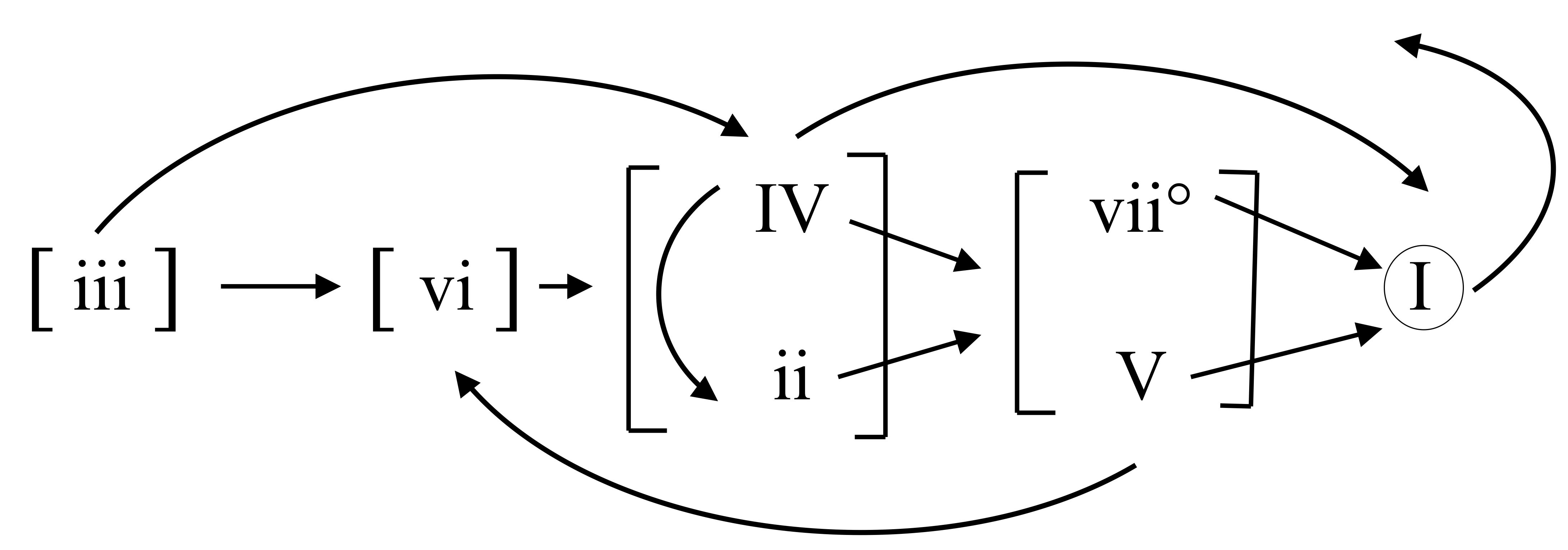
  • It does not use functional harmony progressions, such as ii - V - I, IV - I, V - vi, etc., because these are the harmonic building blocks that establish a key in tonal music.
  • It does not follow the voice-leading conventions of tonality that apply to the resolution of tendency tones, which include:
    • Chord extensions: 7ths, 9ths, 11ths, and 13ths,
    • The leading tone in dominant harmony,
    • Suspensions and retardations,
    • The 5th of diminished chords.
  • The next two voice-leading practices are common in tonal music, but I don't think they apply to pandiatonicism:
    • The 6 & 4 of the cadential 6/4 (I don't see how pandiatonic music can have a cad. 6/4, since it is part of a progression that typically establishes a key),
    • Most chromatically-altered notes (this is irrelevant if only diatonic notes are used). 
  • Can pandiatonic music have a tonic chord or tonic note? As you can see in the discussion below there is disagreement on this. My feeling is that it can, as long as it is not established by the means used in tonal music. Establishing a tonic note or chord through non-tonal means can be challenging, but it is not impossible

Another problematic aspect is that it is defined differently by different people. For example:

  • The Wikipedia article on Pandiatonicism states that "all seven degrees of the diatonic scale [are] used freely in democratic equality."
    • I believe that this idea came from Slonminsky (1938). I take this to mean that there is no hierarchy of diatonic notes and triads, unlike tonal music, in which different notes and triads often have specific roles to play, such as dominant-function chords (V, vii°), predominant-function chords (IV, ii), and tonic chords.
    • The composer in me finds this to be an interesting idea. The problem with this description, however, is that I don't think that many of the works cited as examples of pandiatonicism have this quality (democratic equality of all diatonic notes).
  • Richard Kostelanetz, in A Dictionary of the Avant-Gardes (2013, 465) writes: "The functional importance of the primary triads...remains undiminished in pandiatonic harmony." (Wikipedia says that this "appears to be quoting Slonminsky," FWIW.)
    • I find this an odd statement. How is music in which primary triads have undiminished functional importance any different from tonality?
  • On the other hand, Bryan R. Simms argues that "pandiatonicism does not project a clear and stable tonic" (Music of the Twentieth Century: Style and Structure (1986, 63-64). 
    • This is closer to my understanding of pandiatonicism.
  • Also from Wikipedia: "Pandiatonic music typically uses the diatonic notes freely in dissonant combinations without conventional resolutions and/or without standard chord progressions, but always with a strong sense of tonality due to the absence of chromatics."
    • I agree with the everything in the above statement until the last part: "always with a strong sense of tonality due to the absence of chromatics.
    • Wait… what? There are two problems with this statement:
      1. Tonality isn't defined by an "absence of chromatics." Almost all tonal music uses chromaticism, such as modulation, applied dominants, mode mixture, augmented sixth chords, etc., at least in classical and jazz music. "Chromaticism" comes from the Greek word for "colour," which conveys the implication that music without it is colourless.
      2. If you play a random series of pointillistic white notes or white note clusters on piano, will it necessarily result in music with a "strong sense of tonality?" Tonality isn't just about the notes used in a passage of music; it's about the way those notes are used. The only way for music to have a "strong sense of tonality" is for it to be tonal, which usually includes chromaticism.
  • In Slonminky's 1947 edition of his Music Since 1900 he suggested that pandiatonicism can be considered to be "a diatonic counterpart of Arnold Schoenberg's twelve-tone technique, whereby melodies may be made up of seven different notes of the diatonic scale, and then be inverted, retrograded, or both. According to this system, "strict pandiatonic counterpoint" may use progressions of seven different notes in each voice, with no vertical duplication" ("Pandiatonicism," in Wikipedia, the Free Encyclopedia. Retrieved 21 Jan, 2024).  
    • This is an interesting compositional idea that might be fun to try, but I would suggest that almost no works that get cited as examples of pandiatonicism have this quality.
    • I will also suggest that Slonminsky was writing as an advocate for the concept of pantdiatonicism here, not as an impartial scholar making observations on existing musical practices. I'm not sure that he included any examples of diatonic serialism. This is not to suggest that such examples don't exist – Aaron Copland tried this, and possibly Stravinsky as well (I'll try to do some more research to find out more about this).
Here is my suggestion for composition students: I encourage you to try writing something that can be considered pandiatonic if the idea interests you.

However, given the fact that a universally agreed-upon definition of pandiatonicism does not exist, I would to suggest the following guidelines:
  1. Avoid anything in melodic lines or harmonic progressions that suggests tonality.
  2. Avoid establishing a tonic. Or if this is too disturbing, establish a tonic, but not by any method associated with tonality; for example, Ti-Do and So-Do, if supported by dominant-to-tonic (or dominant to sub-mediant) harmony, are overtly tonal and should therefore be avoided.
    → On the other hand, if Ti-Do is supported by non-tonic-to-dominant harmony, such as iii to ii7, or I7 to IV, it is available.
  3. Aim to use all pitches of whatever scale you use equitably and democratically.
  4. Triads may be used only if they do not progress as they do in tonal music.
    → See the Kostka & Payne chord progression chart below for a summary of how diatonic chords usually progress in tonal music.
  5. Try to use non-triadic constructions as well, such as quartal and quintal harmony.
    → One challenge in using these types of harmonies is that, depending on what note you start on, you might end up with accidentals if trying to maintain a vertical structure of perfect fourths, such as C - F - Bb - Eb - Ab, etc. While occasional accidentals are fine in pandiatonicism, for the most part the objective is to avoid them. They are fine if required for modulations, however.
    → If you want to write quartal harmony using only perfect fourths and white notes (i.e., no accidentals), for example, you could build up from B: B - E - A - D - G - C - F.
    → If you want to try this with quintal harmony, build up from the last note above (F): F - C - G - D - A - E - B.
  6. Give Slonminsky's serialist diatonicism a try if you wish.
You may find it challenging to write music you enjoy without borrowing common practices from tonal music; therein lies the reason tonal music is so widely embraced: Its practices have evolved over centuries to sound good to Western ears. We talk about Ti "wanting" to rise to Do in a V-I progression, or of a chord seventh "wanting" to resolve down by step to a consonance in the next chord, or a 4 "wanting" to resolve down to 3 in a 4-3 suspension, because these practices sound good or "right" to our ears, so writing tonal music in which these practices are not followed can feel very "wrong" to us.
(On a side note, I am curious to know if the tonal music practices that sound "right" to our ears have corollaries in music of other cultures, such as South-Indian classical music, or traditional Chinese music. Do they use anything like dominant-tonic harmony?)
For this reason, you may find it easier to write pandiatonic music that avoids triadic progressions, such as Slonminsky's serialist approach to diatonicism, or pointillistic music in which widely-spaced notes are distributed in unpredictable ways.

I'll stop here for now; I will post some links to pandiatonic music in my next blog post.

Please let me know your thoughts below in the comments section!


How diatonic chords in classical music usually progress: Chord-Flow Chart (from Kostka, Stefan M., and Dorothy Payne. Tonal harmony: With an introduction to twentieth-Century music. New York etc.: McGraw-Hill, 2009. P. 111):


Check out the next post, Pandiatonicism 2, to listen to various works that some have claimed to be pandiatonic.


You may also like these posts on Post-Tonal Harmony Ideas:


Sunday, March 12, 2023

The mad scientist of music | Mark Applebaum

Do you find this interesting? Is it music? No need to answer the second question, by the way, unless you feel like doing so.

Check out this TED Talk by composer/creator Mark Applebaum and please share your thoughts in the comments below:


If you didn't click on the link in the second paragraph above to Mark Applebaum's bio page in Wikipedia, the very brief version is that he is a full professor of music composition and theory at Stanford University.

Tuesday, February 22, 2022

Film Music: "The Minions Do All the Writing?"

Interested in writing film music? Here's a link to a Vanity Fair article that claims that the majority of film composers, including "big-name" composers such as Hans Zimmer, farm out much of the composing to uncredited "ghost composers," most of whom are paid very poorly and gain no recognition for their work, even when their work leads to Oscar and Golden Globe awards for the big-name composers who take all the credit. Here's the link:

“The Minions Do the Actual Writing”: The Ugly Truth of How Movie Scores Are Made

John Williams is apparently a rare exception to this practice; he reputedly writes all his music himself. 

Thursday, January 7, 2021

Daring to Dream Big – Pros and Cons (2)

Are you pursuing a dream?

About six years ago, I wrote a post about the risk assessment exercise we go through when deciding to follow a dream: Daring to Dream Big – Pros and Cons (1)

Then, a few days ago, I saw a related question in Reddit:

Redditors who gave up pursuing their 'dream' to settle for a more secure or comfortable life, how did it turn out and do you regret your decision?

If you have a dream, you may have asked yourself questions such as the following, or you may begin to question these things at some point in the future: 

  1. For how long should I continue to follow my dream?
  2. If I give up my dream, can I be content knowing that I gave up my dream, or will I regret it for the rest of my life?

The Reddit question above triggered hundreds of responses, many very thoughtful, which suggests that it resonates with many people. 

For some, the answer was that giving up on their dreams turned out “great.” Here’s one example:

Turned out great, just not right at the moment as I am still job hunting after having to quit my previous job. Still no regrets though.

I went to college to become a 3D animator. Something I always dreamed about. I was top of the class, constantly won awards for my work. I honestly thought I was going to make it big. Then the final semester started and all the seniors were required to go to a special hiring event where tons of big names would be. I got my portfolio and resume copies ready to go, and spent hours researching the big names and their projects as well as rehearsing lots of practice questions.

It was devastating. No one would look twice at my stuff. Introduced myself, made some awkward small talk as they were so disinterested, then as I walked away they would immediately put it in the stack with hundreds of other portfolios, and not in the special pile.

I switched up my game. I started introducing myself with a quick mention that I had a background in programming (I did). Thinking that maybe that would give me an edge. Oh boy did it work. Suddenly I was getting personal business cards, phone numbers and emails, my resume was put on the special pile.

It was at that moment I realized I went into the wrong field. I was just a tiny insignificant drop in a sea of artists, many of whom were much more talented than I could ever be.

Finished up my degree and went back to college for a BS in Computer Science. Got my first job right out of college from .an internship I did over the summer. The job itself was heaven, and I really enjoyed it. It also helped that I made bank when I was there. Paid off all my school loans within 3 years and had plenty to invest and put into savings.

While it sucks not having anything right now, I'm hoping to find something soon.

Side note: The 3D stuff I still do as a hobby. Not nearly as good as I once was, but it is still fun and relaxing.

I have heard similar stories elsewhere, including at a fancy, large, dinner party thrown by a very very wealthy investment firm executive, and attended largely by other investment firm executives, company presidents, and the like. The occasion we were celebrating was a milestone birthday of the investment firm executive. You might be wondering why I was invited. Did I receive the invitation by accident? 

No. I was invited because the person throwing the party has been one of my best friends for over 40 years. We were both in very different circumstances when we met, however; we had just finished our bachelor’s degrees from U of Toronto (mine in humanities, his in political science), and we were working as telephone information operators at Grey Coach bus lines. I was immediately impressed by his intelligence and broad, encyclopaedic knowledge, which included a strong interest in music. We became friends quickly, and we spent many hours talking about all manner of things.

His dream was to work in the foreign service, and, in pursuit of that dream, he read voluminously about history and politics in other countries, particularly in Africa, and he took the Canadian Foreign Service Exam. It is hard to imagine that he did not do well in this exam, but he was never notified of his results. After waiting for a while with no notification, he decided on a whim to take the Graduate Management Admission Test (GMAT), which is required for applicants to MBA programmes in Canadian universities. He scored very well – no surprise –  AND he was notified of his results (a bonus! 🥳), so he applied to some MBA programmes, and was admitted. He now runs a very successful investment firm.

He gave up his dream and decided on a different path mostly on a whim, and ended up doing so well in it that he has no regrets whatsoever. 

This was similar to some of the stories told by other people seated at my table at this dinner party, some of whom had aspired to be musicians when they were young, but these aspirations had not worked out. They were all so successful in business ventures that they lived privileged and comfortable lives, and had, apparently, no regrets at all about giving up on their initial dreams.

It would appear from this that if you give up your dream but end up making a lot of money, it makes it much easier to have no regrets about your decision. I don’t know if money can buy love or not, but it can sure make life a lot more comfortable, which in turn can make it easier to find partners willing to share their lives with you.

Here’s another Redditor’s experience:

This is EXACTLY why I left the VFX industry. It fucking sucks. There is no work life balance. It’s 90+ hour weeks non-stop. Then the project ends and you’re jobless. “Good luck man. Thanks for the hard work.” Now you most likely are going to find the next project in another state and have to move the family.

I was top of my game and getting paid really well. Won an Emmy and some golden globes, one of my projects got nominated for an Oscar, built a AAA game and I can tell you with zero hesitation that none of that shit means anything.

Every time I hear kids that want to get into VFX or games... I stop them dead in their tracks with advice they need to hear, not want to hear.

Oh and a word of advice to anyone in any industry but especially VFX, it’s ALL about who you know. So get used to buttering up people.

Sooooo glad I left.

The message here is that sometimes your dream can turn into a nightmare, or at least into something that you weren’t expecting. Having one’s dream turn into something we weren’t expecting is probably extremely common, because we generally don’t have an accurate sense of what our dream job will entail until we actually start doing the job. 

Not having an accurate sense of what our dream will entail is not necessarily a bad thing, however. I knew that being a professor would involve teaching and creative activities (composition, my case), but I didn’t realize how much committee work there is, or how onerous it can be. However, it is part of a job that I’m lucky to have, and I realize that committee work is very important too, so I’m fine with it. 

Some people discover that they are really good at administration and they enjoy it, which can lead to a change in career path from professor to administrator (dean, associate dean, president, vice-president, etc.). The dream can change along the way, and usually does.

More problematic, however, is that for me the process of becoming a professor involved 15 years of poverty after finishing my BA, which contributed to high stress levels, the demise of my first marriage, depression, and a general sense of “why the hell am I doing this?” much of the time. I still don’t know why I stuck with it for as long as I did, except that I was convinced I could be both a good composer and a good teacher because I had had rewarding experiences in both areas. However, by the time I turned 35 I had pretty much reached the point of deciding that I could not keep doing this much longer and needed to refocus my aspirations on a plan B or C. 

It’s one thing to be poor in your early twenties, but it becomes harder to live with the older you get. 

Plan B, by the way, was to keep doing what I was doing, which was teaching at the Royal Conservatory of Music for below poverty-line wages while being part of a composer's collective that put on about 4 concerts a year of our music, some of which were picked up by the CBC. Plan B kind of sucked when it came to making a living, but at least I got to do things that I enjoyed. Plan C was to find out how to get a realtor's license and sell real estate.

Then, improbably, fortune smiled on me: At the age of 35 I was hired to teach composition, theory, electronic music, and orchestration at MUN, and I won prizes at a couple of composition contests that year. 

This is from a Redditor who abandoned the dream of an academic career:

I left after half a PhD in English. I think the moment I checked out was watching my tiny, 76YO professor totter home from the office at 10pm. She had probably taken a 16-hour work day. "You mean I have to work this hard, only to earn the privilege of working that hard?" I thought to myself.

That, and the fact that the work was colonizing every waking hour, and that I was not coping in healthy ways.

I still miss lots of things about it. I made some of my very best friends in graduate school, and I felt like I was part of a community. Now, I often feel like I'm wasting my life making someone else money.

On the other hand, I've been able to travel all over the world, thanks to the income I get. I'm married, own my own home, and I just had my first child. So things are very, very good. Maybe one day I'll find work that is fulfilling.

EDIT: I work as a technical writer, which is a career path I can definitely recommend for those who went down the same path I did. Many are asking for friends and relatives studying English, and regardless of whether they pursue the career, studying technical writing will improve concision, audience analysis, and clarity. I cannot recommend it enough.

For what it’s worth, the suggestion that academics normally work 16-hour days seems a wild exaggeration, at least in my experience. The normal workload for me during teaching semesters is perhaps 8- to 10-hour days, usually 7 days a week. It’s a job where, no matter how much work you do, you hardly ever go to bed at night feeling like you've finished all your work and you're fully prepared to teach the next day, at least during a semester. 

On the other hand, once a semester is over and all marks have been submitted, academics have a lot of time in which to  pursue our projects, such as composing, performing, learning repertoire, writing books and research papers, or starting the process of preparing for the courses we will teach in the following semester. On balance, it’s an exceptionally good deal, especially since I love teaching and preparing for classes.

But that’s only if you are lucky enough to find a full-time, tenure track job. And if, once you find it, you succeed in getting tenure. If you don't get tenure, you are fired. That's something I didn't know when I was a student.

The great majority of people with completed doctorate degrees never find full-time academic employment. The first academic job to which I applied had 290 applicants. In many cases in music, applicants have won awards and/or competitions (for composers or performers), and they may have multiple recordings, but they may never even get interviewed for a starting professor position.

On the other hand, it isn’t very hard for PhDs to be hired by universities on a per-course basis, but per-course teaching is wickedly exploitative: According to a recent study, many adjunct professors (a fancy term for “per-course teaching slave”) make less than $3,500 per course and live in poverty.

I know people in their forties with PhDs, who teach twice as many courses as full-time professors for significantly less than half a starting professor’s salary. 

Therein lies the dilemma for anyone aspiring to an academic career; it's mostly a great job if you can get it, but it is extremely hard to get a tenure-track job, and sometimes, even if you get such a job, you don't get tenure and find yourself either unemployed, or employed as a per-course instructor making not enough money to live on.

For all of these reasons it was probably wise for the Redditor above to change paths halfway through his PhD.

Here’s a Redditor’s response to the original poster’s question that struck a note with me (this is a terrible pun; sorry!):

It was fine, but no one gives a shit if you're a professional bassoonist and there really isn't enough paying work.

I did it professionally for eight years before quitting to raise kids. Now I work in IT. If I had to do it over again I'd have just gotten a real job and not put so much time into an instrument that I don't like playing.

Ouch!

Pro Tip: If you don’t like playing the bassoon, then do not pursue a performance career as a bassoonist.

If, on the other hand, you love playing your instrument but can’t find a full-time paying job as a performer, you have many options, such as:

  1. Playing in an amateur or semi-professional (mix of pros and amateurs) orchestra/ensemble;
  2. Making fun YouTube videos of you playing your instrument, possibly with backing tracks, or double tracking (playing two or more different parts on separate tracks);
  3. Teaching – Private lessons;
  4. Teaching – K-12 (for this you will need an education degree);
  5. Consider becoming a music librarian (I know at least three people who did this, and they love their jobs);
  6. Starting a chamber music ensemble made up of fellow music-lovers who can’t find full-time employment as performers;
  7. Organizing a chamber music concert that involves amateur musicians, mostly;
  8. Arrange music for your instrument and play it on-line;
  9. Compose music for your instrument and perform it on-line, etc.

Most of these are not remunerative, but some are, and they all provide opportunities to continue being musically active for those that love music.


Lest today’s post sound like a suggestion that you not follow your dream, remember that the quoted Reddit posts are all responses to this question: Redditors who gave up pursuing their 'dream' to settle for a more secure or comfortable life, how did it turn out and do you regret your decision?

The question is addressed to those who gave up their dreams, and most of the responses reflect that

Had it been addressed to those that acheived their dreams, the responses would presumably been very different!

For me, this thread shows that at least some of the people who have given up their dreams have done so without regret, and, they have gone on to lead rewarding and productive lives. 

However, many people either achieve their dreams, or, in the course of attempting to reach their initial objective discover that there are other dreams they would rather pursue, and they do so successfully and happily.

Sunday, February 9, 2020

Blog Index Organized by Topic – Feb 2020

This list includes most of my blog posts so far, organized loosely by topic.

Entries relating to class business – reminders of deadlines, concert congratulations, order of class presentation, etc. – are not included because they are likely boring to anyone who wasn't in the classes to which they were targeted.

The listed blogs below, however, are intended to be relevant to students of music composition or others interested in composition.

→ Exploring the Creative Process; Struggles and Solutions ←
Strike While the Iron is Hot! (includes section on "writer's block")

→ Planning ←

→ Playing With Expectations; Musical Dichotomies ←

→ Composition Techniques (General) 

→ Composition Techniques Associated with Specific Composers 

→ Form in Post-Tonal Music ←

→ Atonality; What's in a Name? ←


→ Winning and Losing; Judging and Being Judged; Reference Letter Do's and Don'ts ←

→ Audience Response to Contemporary Classical Music and Marketing ←

→ Composition Issues (10-part series that started this blog) ←
1.1. The quality of ideas may not matter very much in assessing compositions that emerge from them; and
1.2. The degree to which these ideas are original may not matter very much.
2.1. Study the music of others.
2.2. Compose as much as you can.
2.3. Invite criticism from others.
3.1. Live with it for a while.
3.2. What is it about?
3.3. Does it change character?
3.4. What is its function within the context of the piece?
3.5. Structural Analysis.
3.6. Harmonic (or Pitch, Scale, etc.) Analysis.
7.1. Less is more / More is more
7.2. Always leave them wanting more / Give them what they want
7.3. Don't treat the listener like an idiot / There's a sucker born every minute
7.4. There can be too much of a good thing / If you have a good idea, then stick with it!
7.5. The George Costanza approach.
8.1. Three models for the role of a composer
8.2. Mastery or Mystery?
8.3. The value of a plan
8.4. Getting stuck, and possible workarounds
8.5. Don't obsess
8.6. Challenges = Opportunities

→ Composition Projects ←

Saturday, February 1, 2020

Beyond Words – 2

My previous post began with several quotes by authors and poets suggesting that music has the capacity to express meaning beyond what is possible with words. Today I will delve a little further into this idea. But first, here are the quoted statements again:

“Music expresses that which cannot be put into words and that which cannot remain silent.”
― Victor Hugo

“After silence, that which comes nearest to expressing the inexpressible is music.”
 ― Aldous Huxley

“Where words leave off, music begins.”
– Heinrich Heine

“Where words fail, music speaks.”
― Hans Christian Andersen (the actual quote is: “Where words fail, sounds can often speak”)

These quotes are poetic, which makes sense since the writers all wrote poetry, but are they valid?


The question of whether music expresses emotions or triggers them has been debated for centuries. Similarly, many have explored the effect music has on us. How do we react to music, and why do we react in the way we do? Plato wrote, “more than anything else, rhythm and harmony find their way into the inmost soul and take strongest hold upon it” (Republic, III, 40Id-e).

Indeed!

On the one hand, there seems little doubt that many people respond emotionally to music. I sometimes find myself moved either to tears when listening to music, not because the music is "sad," but because it is beautiful. Music can trigger in me a myriad of other emotions as well, such as joy, a sense of calm, a sense of excitement that can lead to a desire to move, or even dance (don't worry; I do not do this in public), feelings of wonder, curiosity, religiosity, etc.

I have never really understood why I react in these ways, but I can say with certainty that I often feel profoundly moved by music; this was probably the main motivator that led me to become a composer./musician

On the other hand, some people argue that while music can trigger emotional responses, it doesn't actually communicate anything.

One such person was Igor Stravinsky, who, in An Autobiography (1935), wrote:

“For I consider that music is, by its very nature, essentially powerless to express anything at all, whether a feeling, an attitude of mind, a psychological mood, a phenomenon of nature, etc. Expression has never been an inherent property of music. That is by no means the purpose of its existence. If, as is nearly always the case, music appears to express something, this is only an illusion and not a reality. It is simply an additional attribute which, by tacit and inveterate agreement, we have lent it, thrust upon it, as a label, a convention – in short, an aspect which, unconsciously or by force of habit, we have come to confuse with its essential being.”
I took an aesthetics course during my undergraduate studies (which were not in music; I began studying music after I had finished my first degree), and I remember learning about the nineteenth century music critic Eduard Hanslick, who argued that musical beauty “is self-contained and in no need of content from outside itself.” It “consists simply and solely of tones and their artistic combination” (Hanslick, On the Musically Beautiful, (8th ed., 1891)).

In How Music Grabs the Emotions (2014 article by Dr. Jenefer Robinson, Department of Philosophy, University of Cincinnati), the author writes:
“Hanslick was very concerned to establish that music has no “extra-musical” content, and that, in particular, it does not express or represent emotions. One of Hanslick’s contemporary devotees goes so far as to say that “it is not essential to music to possess emotion, arouse emotion, express emotion, or represent emotion. Music, in itself, has nothing to do with emotion” (Zangwill 2004: 29). In other words, music in itself is nothing but complex structures of tones, a bit like the moves in a game of chess.”
But despair not, those of you who may be wondering what childhood traumas motivated Hanslick, Stravinsky, and others, to churlishly suggest that music is incapable of expressing emotions! There are many scholarly articles in support of the opposite point of view as well, including Robinson (quoted above), PN Juslin, and Malcolm Budd (1989).

Zangwill's notion that music “has nothing to do with emotion” seems absurd to me. I don't know that I would go as far as suggesting that music has everything to do with emotion – music exists on multiple plains, one of which is intellectual (wherein we analyze music, and marvel at clever and  often unexpected things that great music-makers do/did), but for me at least, the main reason I want to explore the intellectual aspects of music is because it moves me, and I'd love to learn learn why and how this happens.

Do you have any thoughts on the question of whether music actually communicates emotion, or does it trigger emotion? Or do you agree with Zangwill that music has nothing to do with emotion?

I lean slightly more to the idea that music triggers emotions, rather than communicates them, but my view on this could change next week. Perhaps it can both trigger emotions and communicate them?


On a related point, we sometimes hear people proclaim that music is a universal language, but I disagree.

Language can be defined as "a form of communication," so, if music is a language, it is extraordinarily imprecise. Even if it does communicate emotions, which is debatable, it does so in an extremely nebulous way, and it is useless at communicating the multitude of specific things we expect language to do.

The "universal" part is also problematic, because we have moved to a point in history in which we acknowledge and embrace the validity and variety of all musical cultures in the world, with none having any superiority to any of the others. Only a cultural imperialist would suggest that the music of any single culture will "speak" to or be understood by all other cultures.

–––––––
Nick Zangwill, “Against Emotion: Hanslick was Right about Music” British Journal of Aesthetics 44 (2004). 29-43.